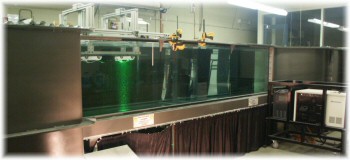
FLAIR Water Channel
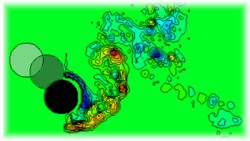
PIV-generated vorticity field of wake behind tethered cylinder excited by vortex-induced vibration in the water channel
A facility employed for studies of many external flows with applications for vehicle aerodynamics, vortex-induced vibration, fluid-structure interactions, wake flows & visualisation, tethered and oscillating body research, transitions in wake flows.
-
Large working section: 0.6m (W) x 0.8m (H) x 4m (L)
-
Speed range 0.05 m/s to 1.0m/s (low speed & high speed modes of operation)
-
Suitable for research over Reynolds number range 50 < Re < 20 000
Lasers & PIV
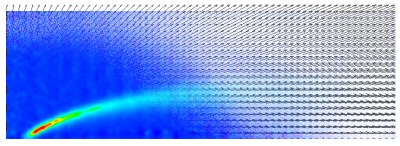
PIV vorticity contours & vector field showing shear layer in flow past a plate (courtesy Andreas Fouras)
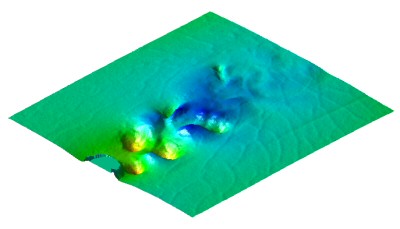
Speckle method free-surface reconstruction showing vortices in wake behind cylinder (courtesy Andreas Fouras)
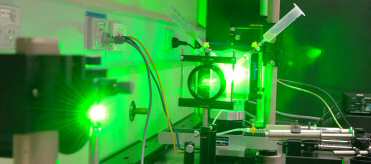
Interrogation of flow through a Y-bifurcation using the the Synchrotron Analogy Facility (courtesy Simon Higgins)
We maintain a number of high powered laser systems to facilitate visualisation and non-invasive optical interrogation of the flows under investigation.
The Particle Image Velocimetry (PIV) technique is used actively by our researchers, and the technique is continually being improved and adapted as we investigate challenging fluid problems requiring micro-scale PIV, the multi-camera stereo PIV technique, or combinations of the two. We have the expertise to carry out:
-
Accurate non-intrusive measurement of velocity, vorticity and pressure in a fluid plane,
-
Digital and high-resolution film-based flow imaging,
-
Three-dimensional vector fields through stereo-PIV,
-
Measurement of surface topology though the Laser Speckle Method - an adaption of PIV software to reconstruct surface elevation by measuring optical distortion of a reference image,
-
Perform measurements of biologically relevant flows at the micro-scale through advanced micro-PIV.
Bioreactor
|
|
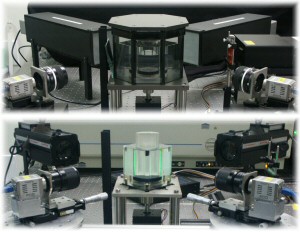
Allows precise investigation of the optimal conditions for cell / tissue growth. Our research has indicated that cell growth is maintained under conditions of low-amplitude chaotic shear stress - high levels of shear stress are to be avoided as this causes cell damage.
|
Water Table
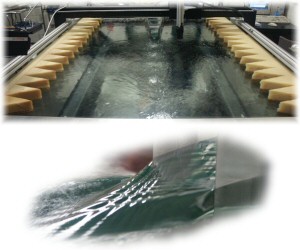 |
The hydraulic analogy between surface wave dynamics and 2D compressible flows is utilised to model a variety of supersonic and compressible flow problems quickly and safely.
|
Swirling Jet
|
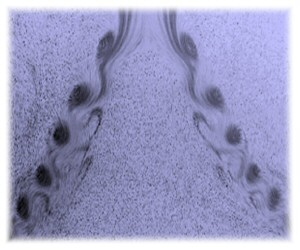
Vortex breakdown is the sudden violent expansion of a vortex. In aerospace and combustion fields, the prediction, control and classification of vortex breakdown is critical. Our swirling jet rig provides researchers with the capacity to do the following:
|
Visualization of a shear layer instability in a swirling jet experiencing vortex breakdown (courtesy S. Khalil) |
Vortex-Induced Vibration
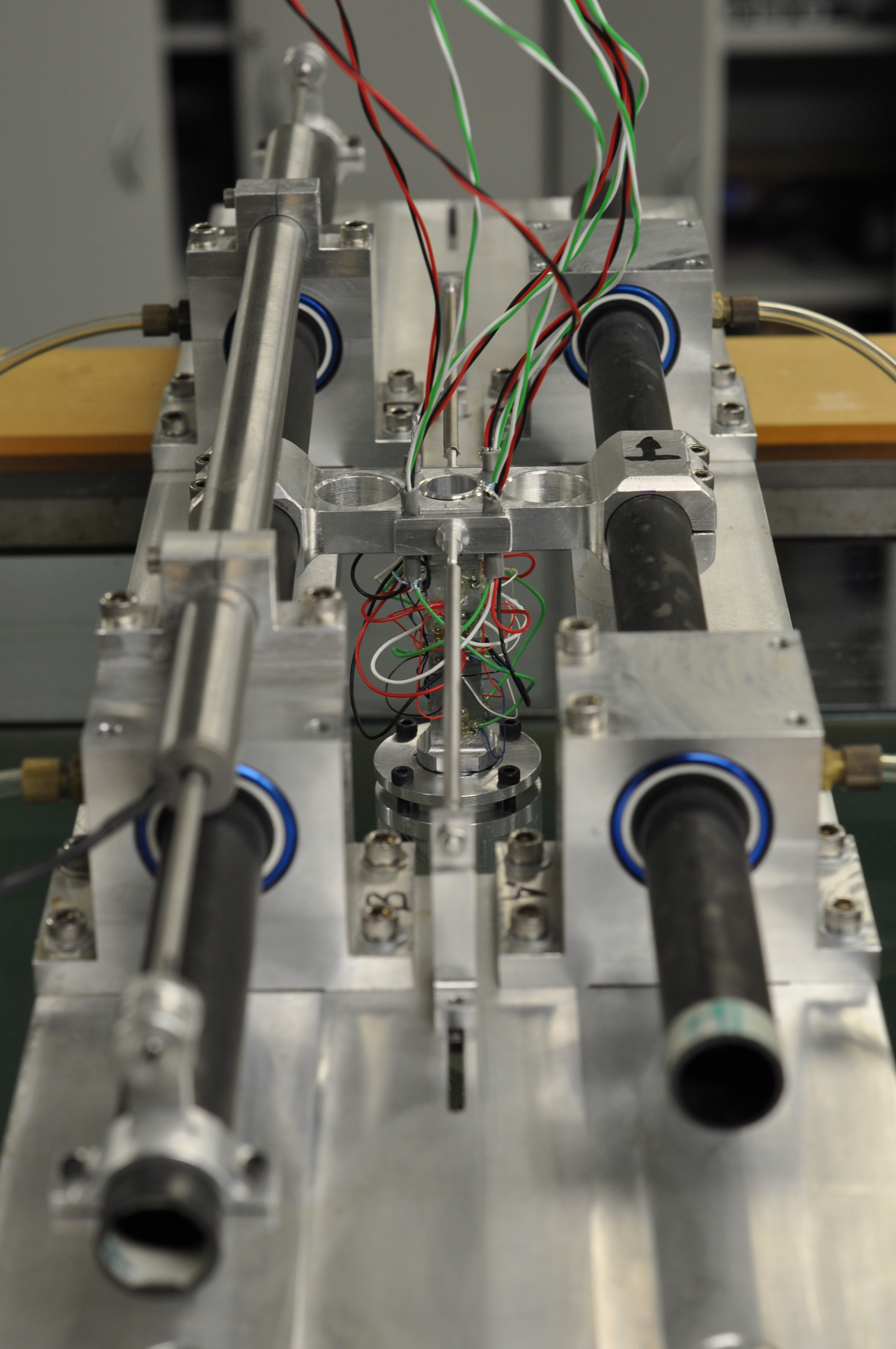
Air bearing rig
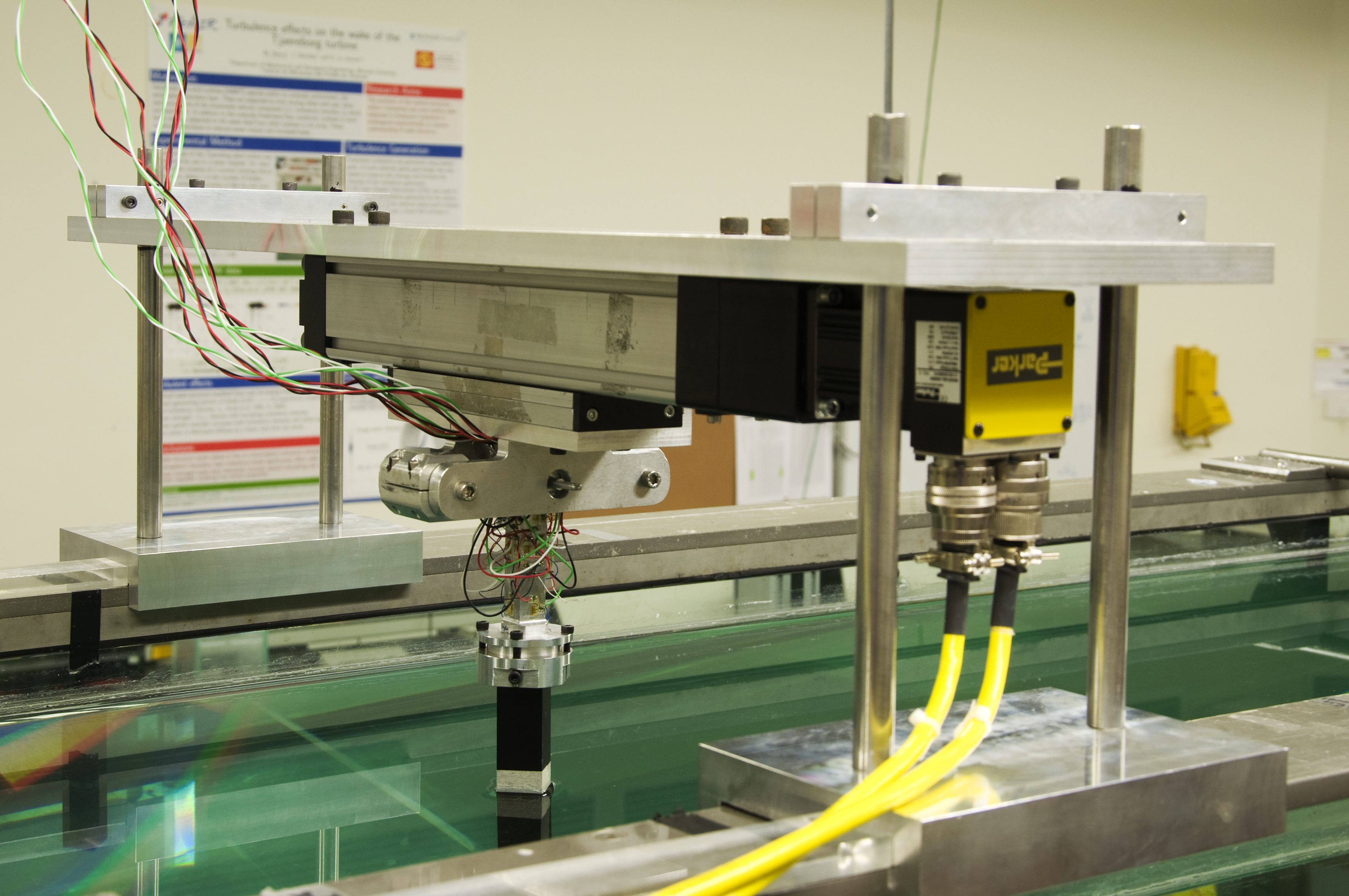
Control rig
Vortex-induced vibration (VIV) of structures is an important problem in the fields of hydrodynamic and hydroacoustic engineering. VIV can have a significant impact on fatigue life of the structure, and can possibly lead to structural damage, or even catastrophic failure. Therefore, the desire to characterize and suppress VIV has received widespread attention. Our VIV rigs are employed for studies of the following aspects:
-
Free vibration;
-
forced vibration;
-
forces acting on the body;
-
dynamic responses of the body;
-
wake profiles behind the body;
-
prediction of VIV;
-
passive and active control of VIV.
High-Performance Computing
We have funded time allocations on the high-performance computing facilities such as,
National Computational Infrastructure (NCI),
Victorian Life Sciences Computation Initiative (VLSCI),
iVEC,
Multi-modal Australian ScienceS Imaging and Visualisation Environment (MASSIVE),
National eResearch Collaboration Tools and Resources (NeCTAR) and
Monash Campus Cluster (MCC).
We have also received data storage allocations for both computational and experimental work via RDSI ReDS scheme. These facilities form the backbone of both the advanced Computational Fluid Dynamics (CFD) simulations performed by
the group, as well as experimental postprocessing and PIV analysis.
Spectral Element Methods
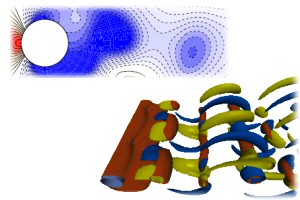
Output from CFD codes se2d/se3d (courtesy K. Ryan and M.C. Thompson)
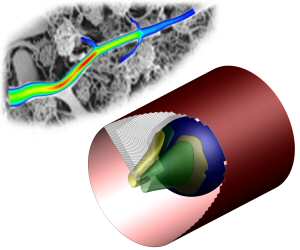
Output from CFD code VIPER (courtesy G. Sheard)
Prof. Mark Thompson and Dr Greg Sheard have each developed Computational Fluid Dynamics (CFD) packages to solve the time-dependent incompressible Navier-Stokes equations governing fluid flow. A spectral-element method is used for spatial discretisation, and time integration is performed using high-order splitting methods.
Spectral element methods are similar to finite element methods, as the computational domain is divided into a grid of elements. However, in spectral element methods, high-order polynomial functions are used to describe the fluid within each element, rather than the linear functions typically employed in finite-element methods. Spatial resolution can then be controlled either by locally varying the density of elements, or by varying the polynomial degree, and less-dense meshes can be employed than with finite-element methods.
The equations of motion are cast in weak (integral) form, and are evaluated using extremely efficient Gauss-Legendre-Lobatto numerical integration over each element, which is exact for polynomials of degree 2N-3, where N is the element polynomial degree.
Time integration is carried out by an operator-splitting approach, whereby the advection, pressure and diffusion terms of the Navier-Stokes equations are solved individually. The non-linear advection term is solved explicity using third-order accurate multi-step integration methods. The pressure term is manipulated to enforce continuity (by requiring the velocity field at the end of this stage to be divergence free). The linear diffusion term is solved using an implicit approach.
Our codes have the following capabilities:
-
Two-dimensional computations in Cartesian and axi-symmetric coordinate systems
-
Three-dimensional computations using both spectral-element-Fourier methods for symmetric bodies, and full three-dimensional spectral elements for complex geometries.
-
Parallel computations through efficient use of MPI and OpenMP statements.
-
Fluid-structure interactions: Vortex-induced vibration, oscillating bodies, simulated wall compliance.
-
Monitoring forces on structures, point velocities in the flow, inlet/outlet flow rates.
-
Predictions of wake transitions and their characteristics using Floquet linear stability analysis.
-
Flow visualisation output suitable for the Tecplot package.
Best viewed on Google Chrome v44.0 or higher | Current date is Sat Apr 27, 2024 4:23 am | Weather forecast for Melbourne
CRICOS Provider Number: 00008C | Monash University ABN 12 377 614 012
© 2005-2024 FLAIR, Department of Mechanical & Aerospace Engineering, Monash University | All rights reserved.
Last modified 22 May 2018 | Contacts | Accessibility
| About this site
Caution
| Privacy
| Webmaster
We acknowledge and pay respects to the Elders and Traditional Owners of the land on which our five Australian campuses stand.