 A spectral-element solver for two- and three-dimensional incompressible fluid flows.
Developer: A/Prof. Greg Sheard
Referencing Viper
Viper users should cite papers from the following list appropriate to the features in the code they employed:
Sheard, G.J., Leweke, T., Thompson, M.C. & Hourigan, K. (2007) Flow around an impulsively arrested circular cylinder. Physics of Fluids 19(8), article number 083601.
- 2D Cartesian solver | 2D particle tracking algorithm
Sheard, G.J. & Ryan, K. (2007) Pressure-driven flow past spheres moving in a circular tube. Journal of Fluid Mechanics 592, 233-262.
- 3D hexahedral spectral element solver | 2D cylindrical solver | Floquet linear stability analysis (cylindrical formulation)
Sheard, G.J., Fitzgerald, M.J. & Ryan, K. (2009) Cylinders with square cross section: Wake instabilities with incidence angle variation. Journal of Fluid Mechanics 630, 43-69.
- 3D spectral-element/Fourier solver (Cartesian) | Floquet linear stability analysis (Cartesian) | 3D particle tracking algorithm
Download Viper
Linux:
-
64-bit (em64) OpenMP shared-memory version: Optimized build: 15 May 2014
-
64-bit (em64) MPI version (requires Open MPI 1.6.3 libraries): Optimized build: 31 July 2014
Windows:
Windows (64-bit): Optimized build: 15 May 2014 | Bug diagnosis build: 15 May 2014
Windows (32-bit): Optimized build: 15 May 2014 | Bug diagnosis build: 15 May 2014
 Viper
Reference Manual (updated 15 May 2014)
Viper
Reference Manual (updated 15 May 2014)
Post-Processing Tools
Extracting the period from a file containing time history data:
The application get_period.exe can be used to determine the period (and hence the frequency) of a time-varying data set. Linux compiles of this code are available on request.
The code takes as input the following:
-
A text file containing a list of <tab> or <space>-separated data. Each row must have the time in the first column, then any number (N) of subsequent data columns.
-
The data column number from which to calculate the period.
-
A reference value of the data at which to calculate the period.
The code works by finding and outputting the interpolated time between successive occasions where the data increases through the reference value. Thus to obtain the correct period/frequency you should choose a reference value which the data only increases through once per period. The code outputs the calculated periods to the screen, as well as a file named period_data.dat.
The code uses inverse cubic interpolation of the nearest four data points to the reference value to accurately determine the time at which the data equals the reference value.
Landau modeling:
Given an oscillatory signal representing the growth or decay of a solution to saturation, the application get_mode.exe can be used to estimate the mode amplitude A (as the envelope of the oscillation), and the quantities |A|2 and d log|A|/dt, which are required to determine the coefficients of the Landau model. The envelope of the oscillation is estimated over time by measuring the absolute values of the differences between successive maxima and minima. Linux compiles of this code are available on request.
The code takes input from text files containing columns of data, as with get_period.exe, and saves the calculated data to a default file mode_evolution.dat.
Change Log
    #####################
    #                   #
    #  VIPER CHANGELOG  #
    #                   #
    #####################

31 JULY 2014:

- Tzekih detected an "output statement overflows record" error during time stepping
  for the linearized Boussinesq Navier-Stokes solver used for linear stability
  analysis. This has been corrected by making the string used to store the text
  prior to displaying to screen.


16 APRIL 2014:

- Added the spatial gradients of the scalar (temperature) field as allowable variables
  for the integrand expressions for the "int" and "intf" commands.

- Added the spatial gradients of the scalar (temperature) field as allowable variables
  for the user-defined field variable (specified using the "-u" option in the "tecp" command.

- Added scalar gradients to the Tecplot output from SE-Fourier 3D simulations.


12 NOVEMBER 2013:

*** Note: Tony has encountered crashing during SE-Fourier 3D MPI
          simulations (infrequently, and on the VLSCI system). This
          appears to be due to multiple processes attempting to
          simultaneously write to the output file. This has not yet
          been fixed ***


- Fixed output from the "LINE" command, where "z" and "r" were being
  written to the output file header for Cartesian simulations, instead
  of "x" and "y".


4 NOVEMBER 2013:

- Upgraded the "RAND" command to work for all flow fields (2D, 3D,
  linearised perturbation fields), in addition to the spectral-element-
  Fourier 3D solver.


19 AUGUST 2013:

- Found the error with Boussinesq computations. This was due to an incorrect scalar
  field (intermediate not end-of-timestep) being used at a point in the time
  integration algorithm. This was especially damaging for simulations using
  cylindrical coordinates because there was a 1/r factor difference between the
  two fields.


16 AUGUST 2013:

- In an attempt to track down the buoyancy-related error that has crept into the code in
  the last few months, checking compilation of the code on different systems and with
  different compilers:
  1) Using different versions of the Intel Fortran compiler on NCI Vayu and Raijin
     produces the same results for Kovaznay 2D flow test case.
  2) Yet to check if buoyancy effects same on both compilations
  3) Compiling the code on Vayu with GNU Fortran compiler found the following:
     a) Errors in "msg_passing" module if compiled as a non-MPI code
     b) Non-standard use of .XOR. rather than .NEQV. for exclusive-or logical operations
        in the recent bandwidth-minimisation experimental code in the message-passing
        section of the code.


15 AUGUST 2013:

- Detected a potentially serious error with the use of index mapping vectors of
  the form "indx_x_to_?", where statements of the form "f_x(:) = f_?(indx_x_to_u(:))"
  were not seeing the LHS being correctly filled with the content from the RHS.
  The same also applied to the "indx_el_to_?" arrays.  This affected some 2D base
  flow derivatives, and several outputs, including the L2 norm. The L2 norm is
  now fixed, and all other affected areas have been replaced with more robust
  loops through all entries in the vectors.
  **** However, note that the Boussinesq buoyancy computations are currently incorrect *****


6 AUGUST 2013:

- Fixed an issue where the buoyancy coefficient may not be set to a default
  zero value if the user did not explicitly set a value when calling "buoyancy".


24 JUNE 2013:

- Fixed a bug in the LOAD routine where interpolating a saved solution onto
  meshes with a different polynomial order was failing due to a vector already
  being allocated - this had crept in during the MPI upgrade.

- Reverted to the behaviour where executing the LOAD routine changes the time
  step to that stored in the file.  This is required as the file contains
  fields at the previous time steps, that would be incorrect if the time step
  is not set to be that in the saved file.


4 JUNE 2013:

- Fixed a bug in the "line" command, which will now correctly output out-of-plane
  component of velocity and its derivatives if the w-velocity field is active
  in a 2D or axisymmetric simulation.

- Fixed a bug with the "-rotate" option recently added to the "tecp" command,
  where it was not correctly defaulting to a zero rotation angle if no rotation
  angle was specified.


3 JUNE 2013:

- Changed "LOAD" routine behaviour - "dt" and "RKV" are no longer changed to
  values stored in the restart file, only "t" is taken from the file - the other
  parameters need to be set in the "viper.cfg" file.

- Fixed an output bug in the "flux" commands where multiple MPI processes
  might each try to write to the same output file, despite only one thread
  doing the calculation.


30 MAY 2013:

- Added a command "LINE", which extracts flow field data along a line from a
  2D simulation.


24 MAY 2013:

- Added an option "-rotate" to the "tecp" command that rotates 2D or 3D
  hexahedral meshes clockwise by a specified angle in degrees about the origin
  in the Tecplot output files. This is useful for aligning visualized results
  with a specified gravity direction vector.


20 MAY 2013:

- Fixed an error reporting bug that was incorrectly reporting errors about
  linearized perturbation field pointers not being associated when linearized
  perturbation fields were not being evolved in a 2D simulation.


7 MAY 2013:

- Added spatial derivative routines capable of acting on the entire element-by-element
  flow field vectors, "dd?_all_elem()".  *** Note these did not give a detectable
  speedup and so have been replaced with the previous code. ***


6 MAY 2013:

- Added a command "AVG_ONE_DIR", which takes a flow field and averages it
  along a specified direction.


5 MAY 2013:

- Modified the "MASK" command so that it accepts separate mask functions for
  each velocity field component, as well as the scalar field variable.


29 APRIL 2013:

- Fixed a bug in the new MPI_BCAST arrangement where an unallocated pointer
  storage was being accessed. The MPI_BCAST code segment should only be used
  when linearized perturbation fields are being evolved in addition to a base
  flow, but this was being executed when no linearized fields were being evolved
  accidentally.


8 APRIL 2013:

- Changed the MPI_BCAST operation during evolution of linearized perturbation
  fields - now all velocity components are gathered together into a single
  broadcast of the base flow field to all processors, rather than calling
  multiple MPI_BCAST calls each time step.


3 APRIL 2013:

- Completed the implementation of constant and linear forcing terms. This is
  implemented in 2D, 3D hexahedral and 2D linearized perturbation field solvers,
  including scalar fields. It is not yet implemented in SE-Fourier 3D simulations.


1 APRIL 2013:

- Began the implementation of "gvar_forcing_fX" and "gvar_forcing_gX"
  commands used to implement constant and linear forcing terms in each
  velocity component momentum equation or the scalar advection-diffusion
  equation. Here "X" may be "u", "v", "w" or scalar field "s".

  *** Have disabled commands that overlap with this forcing facility, including
      "pgrad", "quasi2d", "gvar_lorenz"
  *** Still need to implement in time integration
      --> constant forcing: SE-Fourier 3D,
      --> linear forcing: SE-F 3D


11 DECEMBER 2012:

- Ported Viper to MPI for parallelization. The MPI version, Vmpir, is not
  publicly available, but may be made available on request. Parallelization
  is employed both for SE-Fourier 3D simulations (tested beyond 1000 CPUs)
  and linear stability analysis evolving multiple linearized perturbation
  fields in parallel.


24 OCTOBER 2012:

- Fixed a bug in the advection for scalar fields in Cartesian coordinates
  relating to an incorrect spatial derivative term.


17 OCTOBER 2012:

- Fixed an incorrect vector size allocation issue for the Arnoldi solver for
  linear stability analysis and transient growth analysis that had emerged
  since the recent alteration to the numbering of velocity components. This
  bug only presented itself when different boundary conditions were imposed
  on each of the velocity components.


20 SEPTEMBER 2012:

- Fixed a divergence error in the evolution of linearized scalar fields for
  linear stability analysis in cylindrical coordinates - I had forgotten to
  pre-multiply the intermediate velocity field after the advection substep
  by the radial coordinate.

- A segmentation fault in linearized evolution of perturbation fields in
  cylindrical coordinates with non-zero swirl (w-velocity) was traced to a
  requirement that WVEL be placed before PERT.


17 JULY 2012:

- Updated the code used to advect scalar perturbation fields. Previously the
  advection routines were incorrect/unimplemented for linear stability analysis
  with scalar fields active.

- Moved routines around in source code package. Previously most linear perturbation
  field routines and scalar field routines were in "floquet.f90" and "scalar.f90".
  Now advection, pressure and diffusion routines for base, perturbation and scalar
  fields are grouped in "ti_advect.f90", "ti_pressure.f90" and "ti_difusion.f90".
  This is intended to improve the logic and readability of the source code package.


17 JUNE 2012:

- ###########################################################################
  #                                                                         #
  # Initiating a MAJOR change behind the scenes in Viper's code base. This  #
  # will facilitate the ability to SEPARATELY specify Dirichlet OR Neumann  #
  # boundary conditions for the individual u, v, & w components of          #
  # velocity. This requires new mapping arrays to be built for each         #
  # component, and separate Helmholtz matrices to be constructed for the    #
  # diffusion solves for each component. New "btag" variables "u", "v" and  #
  # "w" can now be specified instead of the combined "vel" specifier,       #
  # though the legacy "vel" specifier will be retained for backwards        #
  # compatibility. Users should compare results using new versions of Viper #
  # with their previous versions to ensure that nothing has been broken     #
  # by this upgrade.                                                        #
  #                                                                         #
  ###########################################################################


18 MAY 2012:

- Fixed a bug in the 'int' command where an un-associated scalar field array was
  being addressed in spectral-element/Fourier 3D computations which did not feature
  a scalar field.


11 MAY 2012:

- Found another bug in the 2D Boussinesq solver that crept in when the "iterate"
  command was implemented - this one was seeing the buoyancy correction use
  potentially the incorrect temperature field vector for the buoyancy term.

- Found a bug whereby a mask used to identify nodes lying on the axis (with
  global velocity numbering) could be corrupted in some scalar field simulations
  conducted in cylindrical coordinates, depending on the boundary definitions.
  This has now been fixed.


10 MAY 2012:

- Fixed a possible error that emerged when "bouss" was called in an axisymmetric
  simulation, where a stress-free boundary intersected the symmetry axis. In
  this situation, it was possible that the inexact stress-free boundary correction
  could lead to a non-zero radial velocity on the corner node of an element sharing
  the symmetry axis and stress-free boundaries. This was leading to contamination
  of the velocity field, first across the symmetry axis, and then throughout the
  flow. Now, at the end of the symmetry boundary correction, the code explicitly
  sets the v-velocity to zero along the symmetry axis.


2 MAY 2012:

- Changed the behaviour of "gvar_dt", "gvar_RKV" and "gvar_scalar_diff" in
  the "viper.cfg" file - they now accept functions of user-defined variables,
  so "gvar_usrvar" functions/variables may be created prior to defining those
  parameters, and the parameters can then be expressed in terms of those user-
  defined quantities.

- Changed the functionality of the "bouss" command to permit separate
  specification of the sign of the required buoyancy (the first coefficient)
  and the magnitude of the buoyancy coefficient. The command now also
  accepts the buoyancy coefficient as a function (including user-specified
  variables).


17 APRIL 2012:

- Added a DEBUG command, which can be called to write more info to screen
  during program execution for bug-hunting purposes. Note that additional
  output will not be large, and will change over time as new features are
  added into the code.

- Added the capacity for iteration of 2D base flow fields to see if rates of
  temporal convergence could be improved for Boussinesq simulations. This is
  invoked using the new command ITERATE.


14 DECEMBER 2011:

- Added a new command "moments" which calculates the moment on a boundary in
  2D simulations.


27 OCTOBER 2011:

- Further minor code tweaks to several routines to correct warning messages
  from "gfortran" compiler.


26 OCTOBER 2011:

- In a behind-the scenes alteration, some source code has been restructured
  to replace Intel Fortran-specific syntax with standard Fortran code, making
  it easeir to compile Viper on non-Fortran systems.


13 JULY 2011:

- Fixed the bug in the "TRACK TECP" binary output routine (I hope!).

- A bug in the "TRACK TECP" binary output routine was detected. Currently this
  feature doesn't work - use "-ascii" option.


9 JULY 2011:

- Added a new function, "track load" to load binary restart files for particle
  transport simulations that are created using the new "track save" function.

- Changed the operation of "track save".  It now outputs a binary restart file
  for particle transport.


8 JULY 2011:

- Added a new function "track tecp" to output particle data in binary or ASCII
  Tecplot point data file formats.

- Changed the "track save" functionality (ASCII output of particle locations) to
  "track saveold" - this is to facilitate the upcoming particle transport restart
  (save/load) functionality.


6 JUNE 2011:

- Added the gradients of the scalar field to the "-vars ddx" output option of the
  "tecp" command. This is implemented for all 2D solutions and 3D hexahedral solutions.


11 APRIL 2011:

- Fixed a bug in the math parser routine, where the function simplifier code was
  returning functions with two negative signs next to each other when it pre-
  evaluated an addition/subtraction of two constants appearing after a negative
  sign, that returned a negative number as the result of the evaluation.
  e.g. 'x - 3 - 5' was becoming 'x--2' rather than realizing that a "-3" is being
       added to a "-5".


4 APRIL 2011:

- Fixed a bug in the math parser routine, where the function "rand" was being
  incorrectly pre-evaluated by the function simplification code.


13 JANUARY 2011:

- Found a bug that slightly corrupts the SE-Fourier 3D solver when a scalar field and
  Boussinesq computation are being carried out. This related to incorrectly mapping
  the differently numbered velocity and scalar fields during advection calculations.


5 JANUARY 2011:

- Modified LOAD behaviour: If called before INIT, the "viper.cfg" Dirichlet boundary
  conditions are applied, overwriting whatever was on those boundaries in the
  restart file.  If, however, the user calls LOAD after INIT, then static
  Dirichlet boundaries remain as whatever they were in the file, rather than what
  is in the "viper.cfg" file.


20 DECEMBER 2010:

- Added scalar field to SE-Fourier 3D versions of "int" and "flux" routines.


16 DECEMBER 2010:

- Added an option "-hugh" to the "save" command to output 2D or perturbation field
  data to an ASCII file readable by SEMTEX, Hugh Blackburn's spectral element code.


13 DECEMBER 2010:

- Added Boussinesq modeling capability to SE-Fourier 3D solver.


11 DECEMBER 2010:

- Problem solved: turned out to be a boundary condition mismatch.

- Tested the "AXIROTATE" command in both the base flow and linear stability
  analysis solver - something not working in perturbation field solver - investigating.


10 DECEMBER 2010:

- Added the "AXIROTATE" functionality to the cylindrical-coordinate
  formulation of the spectral element-Fourier 3D solver.

- Added a command "AXIROTATE", which allows 2D computations conducted in the
  cylindrical coordinate system (with "AXI" activated) to be computed in a
  rotating reference frame.


30 OCTOBER 2010:

- Added a command "INTF", which works like "INT", except it outputs integrals
  evaluated on each mode of a spectral element-Fourier 3D computation, and
  the results are output similar to the "ENERGYF" command. Note that the
  integrand is calculated using the magnitude of the complex Fourier
  coefficients at each mode.
  e.g. This command could be used to generate output akin to ENERGYF, but
  with a conditional mask so that the energy is only integrated over part
  of the domain (say, radial values less than 2 units in cylindrical
  coordinates). The usage in this case would be: \> intf -u 'if(y<2,u^2+v^2+w^2,0)'


- Added an option "-nozero" to the Tecplot output routine "tecp", which removes
  the fundamental mode (zero-wavenumber component) from spectral element-Fourier
  3D data when creating a Tecplot output file. This is especially useful for
  isolating 3D/non-axisymmetric flow structures from swirling flows in
  cylindrical coordinates, for example.


16 SEPTEMBER 2010:

- Modified behaviour of LOAD routine so that static Dirichlet BCs are
  overwritten by what is in restart file rather than what is specified
  in "viper.cfg", provided LOAD is called AFTER "init".


2 September 2010:

- Windows builds are now available for both IA32 and Intel 64-bit architectures.


28 JULY 2010:

- Added the capability for the SVD driver to optimize energy norms containing
  only a selection of the available velocity component / scalar field, rather
  than all of them (i.e. norm E = u^2+v^2+w^2, plus s^2 if active), which is the
  default behaviour.


15 JULY 2010:

- Added the capability for GETMINMAX and SAMPLE to be employed on perturbation fields.


7 MAY 2010:

- Altered the Tecplot output of SE-Fourier 3D data in cylindrical coordinates
  so that if the data set represented a complete revolution in the azimuthal
  direction, the data set would be continuous through the interface between
  2*pi and 0 degrees (this eliminates the appearance of a boundary plane
  visible in the data).


5 MAY 2010:

- Added the ability for the default SAVE and LOAD routines to interpolate onto
  different meshes (using the -m option, just as with the old SAVE/LOAD
  functionality). To use, first the "-m" option must be added when saving a
  solution, and then to interpolate onto a different mesh, include the "-m"
  option when calling LOAD in a new simulation.


1 MAY 2010:

- Added diffusion to 2D and 3D hexahedral particle transport algorithms, by way
  of a Gaussian-distributed random walk. The user specifies the Schmidt number
  using the new "TRACK DIFF" command.


1 APRIL 2010:

- Parallelized calculation of "track sample" output from SE-Fourier 3D particle
  tracking computations, and now carrying out file output of particle data
  only once per time step to hopefully improve the speed of this process.


29 MARCH 2010:

- Fixed an error in a formatting statement for output from "TRACK SAMPLE" in
  SE-Fourier 3D simulations.

- Added the scalar field to MONITOR output from SE-Fourier 3D computations.


21 MARCH 2010:

- An unallocated scalar numbering index was being incorrectly referenced in
  simulations in which the scalar field was inactive, leading to a
  segmentation fault. This has been fixed.


20 MARCH 2010:

- Added scalar field to Tecplot output from SE-Fourier 3D computations.

- Added treatment of scalar fields from SE-Fourier 3D jobs to save & load routines.


19 MARCH 2010:

- The option of adding a scalar field to the SE-Fourier 3D algorithm has been
  added to the code's functionality.

- The particle tracking "track save" routine has been rewritten for SE-Fourier 3D
  computations - now instead of calculating data, opening, writing and closing the
  output file for every particle (which can be many), the code now only opens and
  closes the file once - all calculation and output is conducted while the file is open.
  Have also removed the redundant transformations from parametric to physical space
  and back again. These alterations should make the "track save" command faster.


5 MARCH 2010:

- Added scalar field its spatial derivatives to output from 2D/3D calls to "SAMPLE".


6 FEBRUARY 2010:

- Changed the norm being optimized using the SVD transient growth solver to
  "u^2+v^2+w^2+s^2" when a scalar field is active. Previously, a standard
  kinetic energy norm of "u^2+v^2+w^2" was implemented.


12 JANUARY 2010:

- Altered behaviour of RAND for SE-Fourier 3D computations. By default, less
  randomization is applied to higher wavenumbers. However, this behaviour was
  also being applied even when the user was discretely randomizing a single mode
  (using the "-k" option in RAND). This behaviour has been corrected - now when
  the "-k" option is used, the specified level of randomization will be applied to
  whichever mode is specified.


6 JANUARY 2010:

- Altered output from "energyf" command so that the fundamental mode was listed as
  mode 0, and corrected the behaviour of "rand", so that spanwise/azimuthal Fourier
  modes were randomized from number 0, not 1, when using the "-k" option.


21 DECEMBER 2009:

- Improved the streamfunction output in Tecplot: now a Stokes streamfunction field
  is plotted from axisymmetric computations (thus the streamfunction contours
  align with streamlines for computations in both Cartesian and cylindrical coordinates.


18 DECEMBER 2009:

- Found an incorrect derivative term in the advection step of the linearized
  Navier-Stokes solver in Cartesian coordinates with an out-of-plane (w) component
  of velocity active in the base flow.


15 DECEMBER 2009:

- Fixed an error with particle tracking in cylindrical coordinates, in which an
  interpolation error in the azimuthal component of velocity caused particle
  trajectories to oscillate within elements touching the axis of symmetry.


1 DECEMBER 2009:

- Added the "psi" (streamfunction) variable to the Tecplot output routine. This
  allows a streamfunction field to be calculated and output in a 2D simulation
  without an out-of-plane velocity component.


27 NOVEMBER 2009:

- Removed diagnostic output from SVD computation as testing has shown it to be
  working. This speeds up the algorithm.

- Corrected a pointer initialization affecting initialization of simulations of
  a scalar perturbation field on some platforms.


25 NOVEMBER 2009:

- Modified the Arnoldi solver so that if a user initiates an Arnoldi solve from a
  restart file from a previously converged run, then the solver will recompute and
  ouput eigenvalues/eigenvectors from that run (this capability allows Tecplot or
  Viper restart files to be regenerated from an Arnoldi restart file, or when using
  the SVD solver, it will allow multiple transient growth calculations from a single
  set of computed eigenmodes.

- Fixed an eigenvalue normalization issue affecting the SVD driver routine - this now
  appears to work - for cases with and without a scalar field, this routine seeks to
  find the transient growth based on maximisation of a kinetic energy norm.


15 NOVEMBER 2009:

- Two significant capabilities have been incorporated into the LOAD routine: (1) A new
  option "-r" has been added which allows a user to add the stored flow field in a
  restart file to the present computation, rather than the default behaviour of
  overwriting the existing fields. (2) A new option "-a" can be used to specify a
  scaling factor for the field being loaded.


8 NOVEMBER 2009:

- Replaced two MAT_MUL functions in the static condensation evaluation routines with
  BLAS "dgemv" routines - this has resulted in a small speedup (approx. 5%) in some
  cases.


6 NOVEMBER 2009:

- Now normalising ouput flow field from SVD transient growth routine to unit energy.

- Streamlined the time step timing statistics output further.

- Improved output during Arnoldi iterations - the code now provides more information
  about how many cycles remain in each Arnoldi iteration.


4 NOVEMBER 2009:

- Fixed an error in the output of timing stats for sparse solves in parallel
  computations.

- Modified the QUASI2D command to allow the friction coefficient to be
  supplied as a function.


3 NOVEMBER 2009:

- Altered appearance of "max du" monitors during time stepping.


2 NOVEMBER 2009:

- Added file format checking to Arnoldi restart files. Viper will now report
  an error and abort an Arnoldi call if an existing restart file is incompatible
  (this follows the 25 October 2009 update to the Arnoldi solver).


31 OCTOBER 2009:

- Improved spatial derivative timing test so that more accurate timings
  are calculated when parallel jobs are executed.


30 OCTOBER 2009:

- Fixed the perturbation field time step routine so that zero-wavenumber
  fields can be computed in axisymmetric computations with swirl.


27 OCTOBER 2009:

- Tweaked text output in LSA and TG driver routines.


25 OCTOBER 2009:

- Changed the format of vectors passed to the Arnoldi solver.
  *** Note that this modification makes new Arnoldi restart files
      incompatible with the previous format. ***
  Only the homogeneous node values are passed to the solver, rather than
  the full velocity vectors - the zero Dirichlet nodes have been omitted
  to reduce the size of the Arnoldi matrix problem.
  Also, the real and imaginary components of the perturbation field vectors
  are all sent to Arnoldi as entries of a real vector (as a complex vector
  sent to Arnoldi implies a temporal representation, whereas complex
  perturbation field vectors imply a spanwise spatial representation).


20 OCTOBER 2009:

- Corrected a flaw in the LOAD routine. It was incorrectly giving an error
  if a user tried to map a field onto a Fourier mode in an SE/Fourier 3D
  simulation.


15 OCTOBER 2009:

- Removed a superfluous blank line written to screen at the conclusion of
  the SAVE command. SAVE output should now more closely resemble TECP output.


12 OCTOBER 2009:

- Chris Butler detected an aliasing artefact in vorticity which arose in
  post-processing for Tecplot output from SE/Fourier 3D computations. This
  was traced to incorrect indexing of conjugate (-ve frequency) modes when
  vorticity fields were reconstructed from Fourier modes.


11 OCTOBER 2009:

- Added driver commands for both linear stability (Floquet) analysis and
  transient growth analysis. These are named "LSA" and "TG", respectively.
  These single commands can be used in place of a loop containing ARNOLDI
  and STEP commands.


8 OCTOBER 2009:

- An error with one advection term in the adjoint solver for transient
  growth analysis was uncovered after testing code against Hugh Blackburn's
  SemTeX code. This has now been fixed.


1 OCTOBER 2009:

- Added additional error messages to the PARDISO sparse matrix solver error
  reporting routine to conform to the Intel MKL 10.xxx implementations.


30 SEPTEMBER 2009:

- Added error messages to the LOAD command: If a user specifies a non-zero
  perturbation field number ("-k" option) before FLOQ has been called, an
  error message is reported and the LOAD routine terminates. If a larger
  perturbation field number is supplied than what is active, a warning is
  printed to screen, and the fields are loaded onto the largest active
  field number.

- Joine identified a problem with stability analysis of frozen base flows
  with the ROTATE command active. It was identified that the rotating
  component of the base flow was not being subtracted in spatial derivatives
  of the base flow (this arose from a change to the code on 8 September).


27 SEPTEMBER 2009:

- Slightly modified the names given to output from the Arnoldi command to
  more closely resemble default output from SAVE and TECP, and to remove
  association with Floquet analysis, as ARNOLDI is also used for transient
  growth.


26 SEPTEMBER 2009:

- Added timing output during time stepping in transient growth calculations.

- Added code to the time integration routine for perturbation fields which
  is designed to minimise the error in the first couple of time steps due
  to the unavailability of the full number of velocity fields from previous
  time steps. This is achieved by reducing the order of extrapolations from
  previous flow fields so that only available fields are used. i.e., if the
  time integration order is 3rd-order, then for the first step a 1st-order
  scheme is used, and for the second step a second-order scheme is used.
  Thereafter, the 3rd-order scheme is used as normal.


23 SEPTEMBER 2009:

- The "max du" monitor in the SE/Fourier code was being incorrectly
  calculated thanks to misplaced brackets. This has been rectified.


22 SEPTEMBER 2009:

- Fixed a problem with 3D hexahedral particle tracking - some particles
  were occasionally misplaced during element interface traverses.

- In the particle tracking routien, added a CLOSE statement to release
  the injector coordinate file "track_pts" immediately after the points
  have been read.

- Changed the misleading reference to "Element order N = ..." during
  startup to "Element polynomial degree N = ...". The element order is
  technically N-1.

- Repaired a recently arisen pointer access violation causing the 3D
  hexahedral solver to crash during the INIT call. No time integration
  algorithms were affected.


18 SEPTEMBER 2009:

- Added a run-time check of the speed of three alternatives for computing
  spatial derivatives: sparse matrix-vector product, full matrix-vector
  product, and tensor-product construction (summed from derivatives in each
  elemental parametric coordinate direction). The fastest method is
  determined at run-time, and is used for that simulation. The sparse
  matrix-vector product approach was used previously, but the other
  methods can be significantly faster, depending on the element polynomial
  degree used, etc. Users may notice decent speedups, particularly in the
  advection term, and to a lesser extent in the pressure term, which are
  spatial-derivative-evaluations intensive.


9 SEPTEMBER 2009:

- Followed up on an issue reported by Chris Butler - the Intel Fortran
  compilers (ver 11) issue an internal compiler error when they encounter
  an "OMP ATOMIC" statement in a subroutine which may or may not be in a
  parallel region of code. Temporarily removing these calls (they are not
  solution-sensitive as they are only used for timing statistics).

- Attempting an explicit initialization of the elemental Laplacian matrices
  to zero at the beginning of its construction to see if this avoids the
  NaNs appearing in the matrix when it is build using the Intel MKL 10.1
  libraries on the EM64 xe.nci.org.au machine.


8 SEPTEMBER 2009:

- Stability analysis of multiple wavenumbers now skip fields which have
  converged, permitting runs to speed up as modes converge. Note that to
  exploit this speedup, multiple modes will have to be computed on each
  parallel thread.

- Shifted computation of base flow spatial gradients from within base
  flow and perturbation field advection calculation routines to a
  single evaluation at the beginning of each time step. This will permit
  faster time integration in stability analysis computations. Speedup
  tests have shown improvements of approximately 10%.


7 SEPTEMBER 2009:

- Added an extra optional parameter to the ARNOLDI command which allows
  the user to specify the exponent of the convergence tolerance (the
  default is -7, i.e. 1e-7). Numbers with smaller magnitude (e.g. -5, -4,
  -2, etc.) will converge faster, but with less precision.


6 SEPTEMBER 2009:

- Fixed an issue with the solver for zero-wavenumber perturbation fields
  in cylindrical coordinates, which should allow the zeroth wavenumber
  (axisymmetric) mode to be evolved stably.


5 SEPTEMBER 2009:

- Added checking for infinities as well as NaN values when monitoring
  for divergence of the solution due to instability in time integration.


2 SEPTEMBER 2009:

- The Womersley profile feature has been implemented in both the 2D
  and SE/Fourier algorithms (AXI should be used in both cases).


1 SEPTEMBER 2009:

- Added a feature to WOMERSLEY command which allows the profile to
  be constructed given area-averaged velocity Fourier coefficients
  instead of pressure gradient coefficients.

- Added a command WOMERSLEY which can be used to impose a Womersley
  velocity profile based on supplied Fourier coefficients of an
  imposed time-dependent pressure gradient.

- Added an error report which picks up when a user-supplied function
  has imbalanced brackets.


24 AUGUST 2009:

- When loading from stored flow fields and changing the time step, this
  causes the fields at the two stored previous times to be incorrect. A routine
  has been added to the "SET DT" command to interpolate these previous
  fields to the correct times. Theoretically, this should provide for a
  smoother restart for runs where the time step is abruptly changed.


22 AUGUST 2009:

- Internal code change: On IA64 systems (such as APAC), the 2D time
  integration routine was not being optimized during compilation due
  to its large size. This has now been restructured, with parts of the
  routine being split off into separate subroutines, and compilation
  is again optimized. Users may notice a speedup for 2D simulations
  on APAC.

- Internal code change: Previously was using a condition "Nfloq_modes>0"
  to check if perturbation fields were active. This has been replaced
  by a LOGICAL condition "isFloq", which is quicker to evaluate and
  cleaner in the source code.

- Time integration now includes trapping of divergence due to time-
  integration instability. Viper will immediately terminate if divergence
  is detected. Divergence is considered to have occurred if "NaN"
  is present in any of the flow field vectors.


16 AUGUST 2009:

- Added the capability for RECONSTORE to store spanwise-averaged
  snapshots from SE/Fourier 3D computations (previously only storage
  of 2D quadrilateral or 3D hexahedral solution data was facilitated).
  This will enable stability analysis of the 2D field corresponding to
  a spanwise average of a spanwise-periodic 3D solution to be carried
  out (note that the spanwise-average is simply the fundamental mode
  of the spanwise Fourier modes of the flow field).


14 AUGUST 2009:

- Added evaluation of the present time base field when starting
  transient growth calculations from a reconstructed base flow. This
  may have been leading to a slightly inaccurate startup of the
  perturbation field.


11 AUGUST 2009:

- Added evaluation of the base flow velocity field at two previous
  times at the beginning of transient growth computations in which the
  base flow is being reconstructed (to ensure that the guess of the
  future-time base flow used in advection of the perturbation fields
  is correct). This is also done to acquire the two future-time fields
  for the adjoint (backwards-time) solve in transient growth analysis.

- Further speedups to RECONLOAD: The pressure field is now
  not computed by default, as it is not needed for stability analysis.
  Users can choose to compute this using the "-p" option in RECONLOAD.
  Speedups for Fourier, polynomial and Akima-based reconstructions were
  21%, 28% and 27%, respectively, for the test case used for the 10
  August 2009 tests.


10 AUGUST 2009:

- Added quasi-2D friction term to perturbation fields for linear
  stability analysis: as with the base flow, this term is activated if
  the command QUASI2D is called. It should only be used in 2D Cartesian
  simulations, and the stability analysis will only be meaningful if the
  zeroth (2D) spanwise wavenumber is analysed (i.e. calling FLOQ 0).

- Added BLAS "daxpy" calls for vector-scalar product & sum operations
  in polynomial interpolation routine using RECONLOAD. In a test case,
  a speedup from 4.8 to 4.0 seconds was achieved (17% improvement).

- Added BLAS operations to substantially speed up the Fourier
  reconstruction code using RECONLOAD - a test case improved execution
  time from 31.9 seconds to 2.15 seconds (93% improvement).

- An error was found in the advection term for perturbation fields in
  cylindrical coordinates with a non-zero w-velocity in the base flow
  (e.g. Stuart Cogan's swirling flow in a cylindrical vessel driven by a
  rotating base). This was introduced with the June/July transient growth
  upgrade, and has now been fixed. Tests with a 4 May 2009 build of the
  code verified (a) that the Cartesian and regular axisymmetric solver
  was unaffected (both for base flows and perturbation fields), and (b)
  that there was no difference between predicted stability modes using
  either STAB or ARNOLDI.


9 AUGUST 2009:

- Found a LAPACK work array which was not being properly deallocated
  before a new allocation call - this affected ARNOLDI calls with WVEL
  active only.

- Achieved substantial speedups to polynomial and Akima reconstruction of
  velocity fields using RECONLOAD.
  A test case had 25 elements of order 7, and 20k steps took 50 seconds to
  time integrate. Polynomial interpolation sped up from 77.8 to 4.70
  seconds, and Akima interpolation sped up from 36.7 to 4.61 seconds.


8 AUGUST 2009:

- Added Akima spline interpolation to the flow field reconstruction schemes
  available through RECONLOAD - this should be used in place of polynomial
  interpolation to avoid wiggle artifacts.


6 AUGUST 2009:

- Fixed an array reference bug in RECONLOAD - the pressure field was being
  reconstructed incorrectly, which sometimes led to unexpected crashes due
  to an incorrect array being referenced.


5 AUGUST 2009:

- Fixed a bug in Cartesian scalar transport - the 30 July fix to the
  cylindrical scalar transport algorithm broke the Cartesian solver. Now
  both are fixed.

- Adjusted output of TRACK SAMPLE commands so that the report to the user
  that data is being written is only performed once per call, not once for
  each particle.


3 AUGUST 2009:

- Added to the output of the FLUX command the integrated absolute value
  of the flux in addition to the integrated flux along each boundary.


2 AUGUST 2009:

- Improved ARNOLDI command - now works for multiple perturbation fields.

31 JULY 2009:

- Repaired scalar field timer for 3D hexahedral simulations (it was not
  being calculated), and restructured timers so that the time to
  evaluate the scalar field would be counted for both reconstructed as
  well as integrated flows.


30 JULY 2009:

- Added the potential to use polynomial interpolation as an alternative
  to Fourier interpolation when using RECONSTORE and RECONLOAD (formerly
  FOURIERSTORE and FOURIERLOAD).

- The previously unused cylindrical formulation of scalar advection-diffusion
  contained an error which has now been rectified.

- Identified that the code used to eliminate duplicate interpolated nodes
  in the Tecplot output routine was particularly slow in larger 3D hexahedral
  jobs - attempts are underway to speed this up.

- Corrected output of "max ds" for scalar field computations in 3D hexahedral
  simulations - it now adheres to the minimum 1-second between outputs.


22 JULY 2009:

- Altered how output is displayed during time stepping. Now the step/time/max_du
  information is written at most once per second (thus not every time step is
  displayed). This will produce smaller output files, and will reduce the
  amount of I/O performed by the code - this should be helpful on queued
  systems such as SunGrid, APAC, etc.

- Changed the computation of the change in velocity and scalar field
  monitors during time stepping. Now, instead of outputting the maximum
  change in the magnitude of velocity in the flow, the monitor now
  displays the maximum change in any one of the velocity components (u, v, w).
  This should very slightly speed this calculation up, and will also
  avoid over- or underflow of the calculated quantity.


21 JULY 2009:

- An error in the Tecplot routine for SE-Fourier simulations was
  incorrectly rendering the pressure field - an alternative approach has
  been taken for reconstruction from the Fourier modes.

- An incorrect divisor was used in a MOD() function in the cylindrical
  formulation of the SE-Fourier code. This was causing incorrect radius
  values to be employed when computing the advection terms.

- To aid in bug diagnosis, all versions of the code are currently compiled
  with the "-traceback" option set, which will report routine/line number
  information where an error might have occurred in the source code. Let
  Greg know if this noticably slows things down.

- Joine detected an error occurring during LOAD which was tripped by
  interpolation to a different element polynomial order under the optimized
  "em64" build of the code. This has been fixed by pre-allocating the
  pointer array causing the problem.


20 JULY 2009:

- Fixed bug where a logical vector "radial_mask" was causing the code to
  crash in some 2D runs on Windows due to it not being allocated.

- ARNOLDI now uses the new restart file format (consistent with the standard
  SAVE and LOAD calls). Also, the extracted eigenvector fields are copied onto
  the fields at previous times to avoid an unexpected kick being added to a
  simulation upon restarting.


16 JULY 2009:

- Changed the functionality of L2 and INT commands. They now take their
  parameters as options, and have the added capability of being used to
  evaluate integral norms on perturbation fields was well as base flow fields.
  Note also that the L_2 norm is now computed as the square of the velocity
  magnitude, i.e. ||u||^2 = u^2 + v^2 + w^2.


11 JULY 2009:

- Fixed a problem with the routine used to return the parametric coordinates
  within an element corresponding to a physical coordinate. This issue meant
  that on some occasions during particle tracking or returning values at a
  point (using SAMPLE), the coordinates were returned before the solution
  had fully converged. Note that the worst-case scenario would be that the
  returned point could be between the desired point and the nearest mesh node.


8 JULY 2009:

- Tweaked the allocation of storage for the Fourier reconstruction of
  velocity fields. The facility now will use less memory, and may be
  a tiny bit quicker.

- Fixed an error in the routine used to compute strain rate at a point
  in the flow using either "SAMPLE" or "TRACK SAMPLE" in SE-Fourier
  computations in cylindrical coordinates - the returned strain rate
  may have been miscalculated at the axis.


1 JULY 2009:

- Applied an indexing refinement to the FOURIERLOAD routine, which achieved
  a slight speedup.


30 JUNE 2009:

- Implemented new commands (FOURIERSTORE and FOURIERLOAD) which can be
  used to save a time-varying solution of a two- or three-dimensional base
  flow as a Fourier time series, which can be used in a subsequent simulation
  to supply a periodic base flow for stability analysis computations, for
  instance.

- Deleted some redundant code used to supply the radial distance in the
  global velocity numbering sense for computations in cylindrical coordinates.


23 JUNE 2009:

- The 2nd term in the advection operator for the adjoint operation in
  transient growth computations was incorrect. This has been rectified.


19 JUNE 2009:

- Added the capability of a scalar perturbation field to be used with
  ARNOLDI for stability analysis.

- Added the ability for the SAVE and LOAD routines to recognise scalar
  perturbation fields.

- Scalar perturbation fields should now be plotted in Tecplot files using TECP.

- Cleaned out some unneccesary matrix storage for base and perturbation
  scalar fields.


18 JUNE 2009:

- Added a scalar perturbation field for stability analysis, plus a
  Boussinesq term in the perturbation field time stepping routine. This will
  facilitate stability analysis of Boussinesq flows, and is activated by
  activating a scalar field and calling BOUSS as well as FLOQ.

- Modified the function simplifier to do a better job of trimming zeroes off
  numbers.


15 JUNE 2009:

- Added the capability to compute linear stability analysis of perturbation
  fields with zero wavenumber.


12 JUNE 2009:

- Implemented a trial algorithm for transient growth calculations of frozen
  base flows.

- Fixed an allocation-related crash affecting Cartesian stability analysis
  jobs.


10 JUNE 2009:

- Fixed a minor bug in which scalar transport fields were receiving an
  undesired perturbation upon restarting from a saved file.


5 JUNE 2009:

- Reintroduced a little more output in the LOAD routine - in particular, the
  routine now reports if any parameter values are changed while reading from
  the restart file, and also reports on mismatches in resolution requiring
  reinterpolation.


3 JUNE 2009:

- Fixed a bug in the function simplification routine - functions which when
  simplified occupied a longer string were being accidentally truncated.

- Fixed a bug in LOAD where complex perturbation fields from stability analysis
  were not being mapped onto non-zero Fourier modes of an SE-Fourier 3D
  simulation correctly.


2 JUNE 2009:

- Detected a 2nd error with the LOAD routine in terms of mapping 2D fields onto
  SE-Fourier modes - all fields were being zeroed out each call to LOAD.


1 JUNE 2009:

- Detected an error in the LOAD routine caused by today's earlier fix, which
  could cause parameters to be loaded incorrectly. This has now been corrected.

- Added some further minor streamlining to the function simplification routine.
  Routine should now be a little less memory hungry.

- Fixed a bug in the LOAD routine which will now allow multiple 2D field to be
  mapped onto SE-Fourier modes using the "-k" option.


31 MAY 2009:

- Implemented some memory-saving and time-saving changes to the function
  simplification routine.


29 MAY 2009:

- Made the output of the SAVE and LOAD routines more compact.


28 MAY 2009:

- Restructured the LOAD routine for faster performance. Storage size is
  determined by making a pass of the file, avoiding excessive reallocation
  and copy operations.

- An error was identified in the SE-Fourier algorithm - the symmetry boundary
  correction was accidentally placed outside the loop through the number of
  planes, causing the "k" index to the plane number to be undefined, resulting
  in an out-of-bounds error.

- Replaced some conditional evaluations (e.g. "IF (Ninner > 0) THEN...") with
  a pre-evaluated LOGICAL parameter (e.g. "IF (isNinner) THEN...").


27 MAY 2009:

- Stripped out non-Newtonian code and compressible flow code, which were
  unused, untested, or not implemented.


25 MAY 2009:

- Added a timer for the scalar field in time stepping.


22 MAY 2009:

- Implemented a new command, ORDER, which can be used to change the order of
  the time integration scheme used for velocity or scalar fields. Allowable
  integration orders from 1 to 3 are facilitated.


21 MAY 2009:

- Identified that a use of the FORTRAN function MINLOC to determine the element
  and node numbers of a global number (used in boundary condition, initial field,
  Boussinesq updates, etc.) was extremely inefficient. These have been replaced
  by pre-evaluated indexing vectors.

- Implemented a command "FLUX", which outputs the flux of a scalar field through
  each boundary.


20 MAY 2009:

- Fixed a bug in which scalar fields were not being properly loaded from restart
  files.

- Slightly restructured the parallelization applied to the advection substep of
  the SE-Fourier 3D code.  Small speedups (1% to 5%) were observed in testing.

- Replaced some "divide by radial distance" operations with multiplication by
  a pre-evaluated 1/R quantity for efficiency.


19 MAY 2009:

- Fixed a rare allocation error affecting 2D simulations in which there were more
  curved boundary filaments than there were numbered boundaries. Storage is
  now fully dynamic in the 2D curvature construction algorithm.


14 MAY 2009:

- Improved the code used to print numbers to screen in a neat readable format.
  Now trailing zeroes are removed for numbers in scientific notation as well
  as decimal notation.

- Improved the function simplification algorithm. Functions of constants (e.g.
  "cos(45.23)" are now also pre-evaluated (trigonometric, exponential, log,
  absolute value and square root functions are facilitated. This can make
  user-defined functions smaller, and may result in a slightly shorter
  evaluation (hence compute) time.


- Fixed a bug in "gvar_movref" - if 3 functions were not explicitly supplied,
  the function simplification routine broke down attempting to process a null
  string.


12 MAY 2009:

- Modified the functionality of STOPCRIT - now the current loop iteration that
  is being executed when the STOPCRIT threshold is breached is completed, and
  no further loop iterations are entered.

- Added a safeguard to avoid the endless output encountered when a "viper.cfg"
  file contains an "mesh_file" statement pointing to a file which doesn't exist.
  Now Viper will only prompt for a filename 3 times before terminating.

- Streamlined the SE-Fourier 3D algorithm: Only the positive frequency spectrum is
  stored in the velocity field vectors, reducing the memory footprint of the code.
  Also, all forward & backward transforms now computed at the higher resolution
  employed for advection (either 50% extra modes or 1 extra mode, if the "-alias"
  option is employed in FOURIER or not, respectively). Thus the Tecplot output
  will be interpolated onto a slightly higher number of planes by default.
  These improvements to the SE-F algorithm mean it is no longer necessary to
  perform tweaks to maintain stability - the pressure correction is now again
  enforced on all non-zero Fourier modes, and it is not necessary to explicitly
  enforce the fundamental mode (or the highest mode when the number of planes is
  even) to be real only.


8 MAY 2009:

- As part of the improvements to the SE-Fourier treatment of Fourier modes and
  aliasing (i.e. all BCs and advection evaluated at higher Fourier resolution,
  and only lowest Mfourier_planes/2 nonzero modes being retained in the computations),
  the imposition of symmetry boundary conditions has been reverted to Fourier space
  (this was switched to real space in a recent attempt to hunt down the problem
  affecting Stuart Cogan's simulations, which in fact was caused by the incorrect
  order of the diffusion part of the high-order pressure BC).


4 MAY 2009:

- Chris Butler reported some curious phenomena when complicated boundary conditions
  were imposed on 3D spectral-element/Fourier simulations - namely, if the
  boundary condition energized all Fourier modes in the discretization, then
  the solution was displaying degraded convergence, and the highest pressure mode
  was sometimes being contaminated with spurious artifacts. These effects were
  dependent on the relationship between the symmetry of the boundary conditions
  and the number of planes being selected. These problems were partially
  alleviated by switching off the pressure update of the highest Fourier mode
  in the computation (effectively relaxing the discretization of the pressure
  term). The contamination in the fundamental mode near the axis when an odd
  number of planes was used was found to be due to an insufficient Fourier
  resolution - care must be taken to ensure that sufficient Fourier planes are
  employed to fully resolve the boundary conditions as well as the interior flow.


1 MAY 2009:

- Joine So reported a bug in GETMINMAX which was causing the code to abruptly
  crash. This was traced to a "log10" function that was sometimes being
  supplied a negative argument. This has been fixed.


22 APRIL 2009:

- Added an option "-k" (which can replace the "-n" option) to the FOURIER
  command.  This allows the user to directly specify the number of Fourier modes
  they require in an SE/Fourier 3D computation - this will make parallel
  computations easier to set up, as the number of modes must be an integer
  multiple of the number of available threads for maximum efficiency.

- Added an option "-alias" to the FOURIER command, which can be used to
  specify if the Two-Thirds Rule is employed to avoid aliasing of the advection
  term.  Without this option, advection is computed at the specified resolution,
  which can lead to aliasing on the high-frequency end of the Fourier spectrum
  if insufficient modes are included in the computation.


21 APRIL 2009:

- Repaired an error in the advection term calculations for SE/Fourier 3D
  simulations. The velocity field (u,v,w) components were being incorrectly
  backwards-transformed into real space (derivative terms were unaffected).


7 APRIL 2009:

- Reduced to 2nd order the diffusion term of the high-order pressure boundary
  condition (this preserves 3rd-order accuracy in time for the velocity field,
  Karniadakis & Sherwin, 2005).

- Attempted implementation of a "two-thirds rule" to eliminate aliasing in Fourier
  space due to quadratic terms in the advection substep (SE/Fourier computations).


6 APRIL 2009:

- Modified RAND so that higher modes have a smaller level of random noise applied.
  This is intended to reduce the effect of instability caused by a cascade of
  white-noise energy into the highest Fourier modes.


5 APRIL 2009:

- Altered the way symmetry boundaries are enforced in SE/Fourier 3D computations.
  Now the velocity field is transformed into real space, the symmetry conditions
  are enforced on each plane, and then the fields are transformed back into
  Fourier space. It is hoped that this is more stable than the previous
  implementation, which was causing problems when the high-order pressure BC was
  employed.


2 APRIL 2009:

- Performing the L2 norm calculations with double precision real arithmetic instead
  of complex arithmetic - this is intended to attempt to overcome the precision
  issues detected in l2 norm convergence studies from SE/Fourier simulations.

- Removed the high-order Neumann pressure boundary condition on symmetry boundaries,
  which should be exactly zero anyway. This was done to eliminate a spurious
  fuzziness in solutions detected by Stuart Cogan.


1 APRIL 2009:

- Fixed a rare bug in TECP for SE/Fourier simulations. If the velocity components
  were being plotted in addition to a user-specified field, the u-component of
  velocity was being incorrectly transformed from Fourier to real space. This has
  been fixed.

- Slightly tweaked the "RAND" command for SE/Fourier computations. Complex-conjugate
  copies of positive modes to their negative-frequency counterparts is now done for
  the whole velocity field, rather than just the randomized parts. This ensures that
  the conjugate symmetry of the Fourier transforms are preserved.


31 MARCH 2009:

- Added a command "PBC" which toggles the high-order pressure boundary condition
  on or off (default on).

- Added a user-specified function plotting capability to the Tecplot routine
  (this is activated using the "-u" option).


30 MARCH 2009:

- Chris Butler reported that the L2 norm is still displaying single-precision
  convergence in SE/Fourier computations, despite other integral quantities
  demonstrating double-precision convergence.

- Fixed a problem reported by Nick Boustead with the new LOAD/SAVE commands:
  the code was incorrectly determining the number of data fields written to
  restart files for perturbation fields when no w-velocity was active in the
  base flow.


27 MARCH 2009:

- Added the particle ID number to "TRACK SAVE" output from particle tracking in
  hexahedral computations.

- A compiler optimization error in the Windows version of Viper was overcome
  by adding a "/Qtrapuv" option to force initialization of saved variables.

- In order to improve the precision of the L2 norm integration in SE/Fourier
  computations, all instances of SQRT(), ABS(), SIGN(), MIN() and MAX() in the
  code which operate on double-precision REAL or double-precision COMPLEX data
  types have been replaced by their specific double-precision routine (e.g. DSQRT
  in place of SQRT, etc.).


20 MARCH 2009:

- The SAVE and LOAD routines have been revised. A new format is now in use. Users
  wishing to SAVE/LOAD using the previous format can do so by calling SAVE or LOAD
  with the new "-old" option specified. In addition, if a user attempts to call
  LOAD for an old restart file without this option, the code returns an error and
  attempts to load the data using the old routine anyway.
  The new routines are more flexible, allowing new facilities such as saving and
  loading solutions with scalar fields active, safer loading of 2D solutions onto
  SE/Fourier solutions and vice versa (e.g., loading an SE/Fourier solution onto
  a 2D simulation loads in the zeroth (or fundamental) mode).
  In general it is cleverer, as each field is clearly identified in the file, so
  Viper has a better idea of what it can possibly do with each field.


15 MARCH 2009:

- The SE/Fourier axis filter for cylindrical computations has been disabled by
  default.  Users can still activate a filter by setting the "-f" option in the
  FOURIER command.


14 MARCH 2009:

- The axis filter in SE/Fourier computations was found to slightly shift the
  Kovasznay flow solution from its exact value. Suggest users do not use the
  filter (i.e., explicitly set the "-f 0" option in a FOURIER call in
  AXI computations.

- Fixed the SE/Fourier single-precision convergence issue: problem was caused by
  generic FORTRAN functions for extracting real & imaginary parts of complex numbers,
  and for assemlbing a complex number from two real parts. Some of these were not
  preserving the KIND=8 double precision (64-bit) floating point precision. Have replaced
  all REAL() with DBLE(), CMPLX() with DCMPLX(), AIMAG() with DIMAG() and CONJG() with
  DCONJG().

- While searching for the convergence issue, replaced the EXTERNAL PARDISO calls with
  a "USE MKL_PARDISO" call to the MKL FORTRAN 90/95 interface for the routine. This
  picked up a couple of INTENT statements that could have caused problems.

- Removed the "skip matrix solve if RHS=0" conditional check in sparse solver routines.
  This should never occur anyway.


13 MARCH 2009:

- Encountered an optimisation or compiler bug under Windows - incorrect (or at least
  imprecise) results were computed when degree 2 or 3 elements were used.

- Refined the code for computing integrals from SE/Fourier results using the INT command.

- Added further warning messages to the code used to parse the Viper configuration
  file - more errors are now detected and reported to help users confirm that their
  boundary conditions, etc. are being processed correctly.


12 MARCH 2009:

- Added a warning message to detect if a "btag" command is assigned to a boundary
  which is not included in mesh file.

- Added a warning message when parsing "viper.cfg" files - the code now complains
  if an unrecognised variable name is supplied in a "btag" statement.

- Streamlined the code calculating maximum changes in velocity. for
  display each time step. New approach should be faster (a square root is now performed
  only on the largest "du", "ds", etc., not the whole list of velocities.


10 MARCH 2009:

- Altered the implementation of the Boussinesq approximation - it is now based on
  a principle of calculating the effect of changes from reference temperature & density.


9 MARCH 2009:

- Chris Butler found a rare bug in the "simplify_function_string" code, which
  appeared for functions which had a number of components precisely matching
  the size of the storage arrays for this information. This has been fixed.


7 MARCH 2009:

- A couple of variables in the parallel part of the SE/Fourier time step loop were
  not designated as "PRIVATE" (or separate copies per thread). This may partially
  explain the "max du" convergence issue.

- Corrected a problem with scalar diffusion - a rouge "Nscalar_steps" variable was
  not deleted since the transition to a 3rd-order backwards multistep integration
  scheme for the scalar field.  This was causing the scalar field to diffuse
  incorrectly.


3 MARCH 2009:

- Increased the size of the output of a function insertion routine in "usr_vars.f90"
  to permit the handling of very large compounded mathematical expressions.

- Replaced statically allocated storage vectors in "simplify_function" routine in
  "math_parser.f90" module for more efficient handling of large mathematical
  expressions supplied by the user.


2 MARCH 2009:

- Increased the allowable function string size to approximately 10,000 characters.
  This permits users to compound many user-defined functions into larger expressions.
  Storage for these arrays is now dynamic: the hard-coded allowance for 500 boundary
  is no longer in place.

- Fixed a bug in the boundary assignment code: when processing "viper.cfg" files, if
  multiple "btag" statements duplicated a boundary definition, the code incorrectly
  defined the boundary - the code now robustly assigns boundaries according to the
  last of any duplicated boundary assignments.


28 FEBRUARY 2009:

- Corrected an issue where the pressure field was being incorrectly plotted in
  Tecplot dumps from SE/Fourier computations (the negative Fourier modes were
  being corrupted - this was particularly noticeable if a LOAD operation was
  performed.


27 FEBRUARY 2009:

- Fixed a problem with the SE/Fourier Tecplot output algorithm: the "-cartesian" option
  was not functioning properly when computations were carried out in cylindrical
  coordinates.


25 FEBRUARY 2009:

- Success! Tests confirm that the new version properly indexes the high-order pressure
  boundary conditions, and also permits time integration to proceed without the
  erroneous restriction in time steps.

- Stu identified a problem in which time integration stability had decreased since the
  upgrade to the Neumann BCs implementation. This was traced to an indexing problem
  which was scrambling the boundary nodes on which high-order pressure BCs were
  applied.  This has been corrected, and tests are underway to see if this rectifies
  the time step restriction problem.


24 FEBRUARY 2009:

- Detected an allocation error in the scalar-transport routine - this has been fixed.

- Improved the "gvar_movref" facility - the change is now calculated as a 3rd-order
  time derivative of velocity at the appropriate time, and this acceleration term
  is imposed on the intermediate velocity field during the advection solve.


23 FEBRUARY 2009:

- Changed the scalar field advection/diffusion transport algorithm to a 3rd-order
  backwards multistep method (consistent with velocity field).

- Fixed a bug in the 2D Tecplot binary data file generation routine which only arose if the
  "SR" variable was requested.

- Fixed a pointer association error with a 3D pressure boundary condition vector.


21 FEBRUARY 2009:

- Fixed an indexing error in the cylindrical SE/Fourier Tecplot routine, which was
  causing the strain rate and lambda_2 fields to be corrupted (particularly near the axis.


20 FEBRUARY 2009:

- Strain rate magnitude and lambda_2 fields are still strangely speckledy, despite the
  velocity, vorticity and velocity gradient fields being smooth. This is only present
  in SE/Fourier plots generated from data in cylindrical coordinates... currently searching
  for the problem.

- Identified that the crashing in SE/Fourier computations in cylindrical coordinates was
  caused by a divide-by-zero in a component of the high-order pressure gradient condition
  imposed on Neumann boundaries - initial tests indicate that this correction has fixed
  the SE/Fourier cylindrical-coordinates crash recently plaguing the code.


18 FEBRUARY 2009:

- Identified that the theta-derivative-terms of the rate-of-strain tensor used for strain
  rate calculations was being incorrectly computed. This is being rectified currently.

- Still searching for possible problem with SE/Fourier cylindrical-coordinates shear rate
  issue - lots of scrambled noise superimposed onto data for some reason.

- Tightened file creation in Tecplot routine: existing files are tested to see if they
  can be overwritten immediately before data written to file - thus there is less
  chance that this status will change between the file check and the new file creation.


16 FEBRUARY 2009:

- Investigating a possible problem with the "SR" field in SE/Fourier computations.

- Added a command "gvar_init_scalar_field", which can be used to set an initial condition
  for a scalar field (similar to "gvar_init_field" for velocity and pressure).

- Fixed a bug with STOPCRIT in SE/Fourier computations - it was not stopping the time
  integration loop.

- Fixed some typos in the HELP facility (gvar_init_field had nothing to do with setting
  the non-Newtonian viscosity function).


15 FEBRUARY 2009:

- Neumann BCs now activated for velocity components, pressure, & scalar fields in 2D and 3D
  computations.  This is not yet active in SE/Fourier computations.


13 FEBRUARY 2009:

- Began the rollout of Neumann boundary conditions for velocity, pressure and the scalar field.
  Neumann boundary conditions impose the outward normal gradient of a quantity (e.g. dp/dn) at
  a boundary, rather than the value itself (as with Dirchlet boundary conditions). These are
  selected using boundary type #2 (formerly used for time-independent Dirichlet conditions).
  Neumann boundaries can be specified as a mathematical function, just as for Dirichlet
  (type #1) boundaries. Currently this is implemented for velocity only (requiring 2 or 3
  components for normal gradients of u,v,w fields). Pressure and scalar field Neumann boundary
  capabilities are coming. This feature will be useful for imposing flux conditions in scalar
  field computations - particularly Boussinesq approximations of density-gradient-driven flows.


12 FEBRUARY 2009:

- Identified and corrected a couple of errors relating to the calculation of velocity gradients
  and shear rate fields in the SE/Fourier version of TECP with the "-vars" option active.


9 FEBRUARY 2009:

- TECP "-vars" option is now operational for 2D, 3D, and SE/Fourier simulations. Velocity gradient
  variable names are now correct for both cylindrical and Cartesian coordinates.


7 FEBRUARY 2009:

- Velocity gradient variables added to 2D & 3D Tecplot files output from TECP using "-vars" option.

- Removed the "-o" option in 2D & 3D Tecplot output with TECP. This functionality has been
  replaced with the "-vars" option. Still need to add velocity gradients in 2d/3d TECP routines.


6 FEBRUARY 2009:

- Rolled out an option "-vars" in the TECP command (currently SE/Fourier only), which allows
  users to select which of a number of different variables they wish to include in a Tecplot
  data file. The "-sr" option has now been removed. This new option will eventually replace
  the seldom-used "-o" option.


5 FEBRUARY 2009:

- Fixed a bug in the boundary curvature algorithm which was failing to correctly curve
  boundaries which comprised two 2D element edges.


15 JANUARY 2009:

- A bug was detected with the Floquet solver when base flows were frozen, that had emerged
  during a recent alteration to the way that base flow velocity fields were distributed
  between threads. This has now been corrected. A vector copy was being skipped accidentally
  when "FREEZE" was active.


9 JANUARY 2009:

- Added option "-sr" to TECP command, which can be used to output the shear rate field
  in an SE/Fourier computation.


8 JANUARY 2009:

- Added capability of outputting only a single Fourier mode in SE/Fourier computations
  with the new "-m" option in the TECP command.


7 JANUARY 2009:

- Added "-cylindrical" and "-cartesian" options to the TECP and TEC_FLOQ commands. For
  SE/Fourier 3D computations, and 3D reconstructions of Floquet modes, these options
  can be used to determine whether the velocity components in the Tecplot data files
  are the cylindrical or Cartesian components. The Cartesian form can be useful for
  plotting velocity vector fields in Tecplot (which natively uses a Cartesian coordinate
  system for plotting).

- Removed the particle concentration field from Tecplot plotting of SE/Fourier
  solutions as it was interminably slow to compute.


2 JANUARY 2009:

- Parallelised the particle tracking time integration routine. Testing indicates this
  has been successful, and will produce a solid speedup for particle tracking
  simulations.

- Observed that the TECP output of SE/Fourier computations when particle tracking is
  active is interminably slow. Attempting some speedups and parallelisation to help,
  but may have to rely on TRACK SAVE for plotting.

- Fixed a couple of typos in the HELP documentation.

- Noticed that some OpenMP statements in the source code were incorrectly decorated as
  !OMP rather than !$OMP, and were therefore not activating.  These were only intended
  to activate when single-field computations were being performed, so this does not
  effect the Floquet analysis and SE/Fourier parallelizations.


26 DECEMBER 2008:

- Added time "t" to the variables that can be adjusted using the "set" command.

- Added the capability to include an "=" sign in "set" expressions, and have also now
  added the possibility of changing "RKV", "dt" and "t" variables directly on the Viper
  command line, e.g. "t = 50", "dt = 0.005", "rkv 100", etc.


23 DECEMBER 2008:

- Fixed a bug with the "gvar_lorenz" command, which was not correctly evaluating the
  function during time stepping.


15 DECEMBER 2008:

- Added under-relaxation and additional tolerancing to the routine used to determine the
  parametric coordinates within an element of a physical coordinate on the mesh. This is
  designed to resolve problem of some points very near to a boundary being erroneously
  identified as lying outside the domain.


14 DECEMBER 2008:

- Tests confirm that the parallelisation bug in the Floquet solver has been fixed.


13 DECEMBER 2008:

- Altered the way base flow velocity field data is passed across threads during parallel
  stability analysis - testing underway to determine if this fixes the aforementioned bug.

- Identified a problem with the Floquet solver when running in parallel. If multiple fields are
  being computed per thread (e.g. 8 fields over 4 threads), then the multipliers returned for
  the perturbation fields computed on the same thread as the base flow are nonsensical. This is
  being looked into currently.


11 DECEMBER 2008:

- Added the particle ID number to the output of "TRACK SAMPLE".


10 DECEMBER 2008:

- Re-coded the "AUTOCORRF" routine - the returned autocorrelation is now normalised (that is,
  mean is subtracted from the input signals, and the resulting correlation is divided through by
  the variance). This means now that the returned correlation will always vary between 1
  (correlated), through 0 (uncorrelated) to -1 (inversely correlated).


8 DECEMBER 2008:

- Added two new commands to be used to facilitate magnetohydrodynamical modeling:
  GVAR_LORENZ can be used in the "viper.cfg" file to express functions for the components
  of the Lorenz force, which is then calculated and added to the computation of a 2D fluid flow.
  QUASI2D can be used within Viper to establish a "quasi-2D" treatment of a 3D flow by modeling
  it using the 2D solver with the addition of a friction term, subtracted to mimic the effect of
  friction on the walls of the domain in the out-of-plane direction.


5 DECEMBER 2008:

- The command "sample" has been improved - it should now work for SE/Fourier computations.

- Tightened scratch file creation/removal code in "loop" command - a file that was no longer
  written to since yesterday's update is no longer created.


4 DECEMBER 2008:

- Added a new function to the mathematics parser: "rand(x)".  The function returns a random
  number between 0 and x, and is always treated as a time and space-varying function. That is, a
  different random number is calculated at each node where the function is evaluated, and at
  each time that the function is evaluated.

- Further pointer association problems with particle tracking have been fixed. Now Viper is
  more robust to "track" calls appearing either before or after "init".

- Modified the "loop" code to create smaller scratch files storing looped commands. These are
  invisible on Windows systems, but are visible on Linux systems. Nevertheless, if a very large
  loop is constructed, a significant pause could result as the scratch file containing the
  unrolled loop commands was created. Now these files are much more compact, as the loop counting
  is handled by Viper, and the commands are not repeated in the scratch files.

- Added screen output during loops informing the user how many loop iterations remain.


3 DECEMBER 2008:

- Addressed a bug with "track seed" for SE/Fourier computations - the z-direction pointers were
  not being associated properly.

- Added particle concentration field to Tecplot output of SE/Fourier 3D computations.


2 DECEMBER 2008:

- Slightly modified "max du" output during time stepping: an extra blank has been added to
  clear any extra characters from the line when the next time step is performed.


28 NOVEMBER 2008:

- In ARNOLDI the limitations on number of eigenvalues being sought and the number of Arnoldi
  vectors in a computation (formerly 12 & 30, respectively) have been removed. Storage is
  dynamic, so these limitations are redundant.

- Slightly tweaked the format of output of floating-point numbers to get rid of annoying
  blank spaces in output.


25 NOVEMBER 2008:

- Have modified the Tecplot plotting routines and the particle tracking routines to rectify
  some issues with SE-Fourer particle tracking not following the flow properly.


21 NOVEMBER 2008:

- Observed that particles were not following the flow precisely when flowing across an (r-theta)
  plane in cylindrical coordinates. This is being corrected.


20 NOVEMBER 2008:

- Fixed some bugs relating to the plotting of SE/Fourier computations, as well as particle
  tracking in SE/Fourier computations - particularly in a cylindrical framework.


19 NOVEMBER 2008:

- Implementation of the particle tracking algorithm in the SE/Fourier 3D flow solver has been
  completed. The particle concentration field in Tecplot output has not yet been implemented
  for these computations. The track_pts file should contain points in the coordinate system
  being computed in (i.e. x-y-z for Cartesian, z-r-theta for cylindrical).


18 NOVEMBER 2008:

- Beginning to roll out an extension of the particle tracking algorithm to the SE/Fourier code.


17 NOVEMBER 2008:

- Implemented the Neumann high-order pressure boundary condition in computations of the
  perturbation fields in the stability analysis solver, and in spectral-element/Fourier
  3D computations. These solutions should now be formally 3rd-order accurate in time.


13 NOVEMBER 2008:

- The issue with ARNOLDI producing quasi-periodic modes may be a round-off error issue.
  Test cases suggest the imaginary component is very small. Further investigation underway.

- For ARNOLDI, when base flows have 3 components (using WVEL), the complex matrix capabilities of
  the ARPACK package are now being used. It has been shown that this produces the same results as
  the previous treatment. This revision to the code has modified the Arnoldi restart file created
  by Viper (it is now substantially smaller) - users will not be able to restart from Arnoldi runs
  from earlier versions of the code.


12 NOVEMBER 2008:

- Added extra output to ARNOLDI routine: the error/information messages reported by the
  ARPACK subroutines are now output to screen.  This information is provided to the user
  as the ARNOLDI iterations can occasionally fail for some combinations of parameters, etc.

- Stuart Cogan reported that ARNOLDI is returning complex Floquet multipliers when the power
  method predicts real multipliers during cylindrical computations with swirl (non-zero azimuthal
  velocities). This is being investigated further.


13 OCTOBER 2008:

- Added a new functionality to RAND: now using the -k option, randomisation can be
  applied to a single mode.


10 OCTOBER 2008:

- Fixed a small bug where some out-of-range integers were incorrectly displaying as
  negative numbers during startup and initialisation for very large jobs. This did not
  effect the flow calculations.


7 OCTOBER 2008:

- A bug was detected in the SE/Fourier algorithm: When time-dependent boundary conditions
  were used during a parallel simulation, the Discrete Fourier Transform package used to
  calculate the Fourier-transformed boundary conditions returned incorrect results. The
  Fourier transforms are now performed outside the parallel loop.


30 SEPTEMBER 2008:

- Fixed a bug in the Tecplot Floquet reconstruction routine - in cylindrical coordinates,
  the radial and theta (v & w) components of velocity are now output in cylindrical
  coordinates.


26 SEPTEMBER 2008:

- A bug in the Tecplot plotting routine has been addressed, where vorticity components
  in cylindrical coordinates were being incorrectly computed.

- The TEC_FLOQ routine has now been updated to include velocity components.

- Reintroduced a filter to the SE/Fourier modes - the highest-frequency modes are forced
  to be zero - the complete removal of the 2/3rds rule yesterday resulted in unstable
  computations.

- Added a command "AUTOCORRF", which outputs the spanwise autocorrelation of the
  velocity components at a sampled point on the spectral-element mesh.

- Found and rectified a bug in the "SAMPLEF" routine - an incorrect reference to v & w
  velocities was corrupting the results.


25 SEPTEMBER 2008:

- Removed the "2/3rd rule" filter applied to the out-of-plane Fourier modes in
  SE/Fourier computations. This was introduced during implementation of the scheme in
  an attempt to stabilize computations in cylindrical coordinates, though a separate
  radial filter is also applied in those cases, so this filter was unnecessarily
  limiting. The 2/3rd rule requires that the highest-frequency 1/3rd of the Fourier
  spectrum be rendered equal to zero to guarantee that aliasing is not occurring
  (aliasing is the erroneous appeaerance of energy in high-frequency modes due to
  insufficient resolution in a Fourier transform.
  *** Users should contact Dr Greg Sheard if this causes problems in SE/Fourier calcs ***

- Added a new command "ENERGYF", which outputs to a text file the integral norm of the
  energy in each Fourier mode of a spectral-element/Fourier computation.


23 SEPTEMBER 2008:

- Added a command SAMPLEF, which can be used to output the Fourier coefficients of the
  velocity field at a point in the computational domain during SE/Fourier computations.

- Altered the behaviour of the RAND command in SE/Fourier computations - now the imaginary
  components of the non-zero modes are also randomised.


16 SEPTEMBER 2008:

- An immersed-boundary feature has been added to the code - this experimental feature
  currently synchronises with an external algorithm that tracks a boundary immersed
  in the flow.


9 SEPTEMBER 2008:

- A memory deallocation bug was preventing repeated calls to "init" since the OpenMP
  parallelization of recent months. This has been fixed.


8 SEPTEMBER 2008:

- A bug was reported with the Arnoldi routine - on Linux systems the code crashes
  while writing Tecplot files. The bug was isolated to an OPTIONAL argument of the
  Tecplot output subroutine, which was not being treated properly. The Arnoldi routine
  did not supply this argument, causing its value to be undefined. This has now been
  fixed.

- A bug was reported in the cylindrical-coordinates stability analysis solver, where
  an incorrect function argument was causing the code to fail without explanation. This
  has been fixed.


14 AUGUST 2008:

- Fixed a bug in the SE/Fourier implementation of the "forces" command - previously
  zero forces were output - now forces are computed from the fundamental mode of the
  Fourier expansion - this is not currently correct for the cylindrical formulation.


13 AUGUST 2008:

- Added a Boussinesq approximation for buoyancy-driven convection to the 2D and 3D
  hexahedral solvers. This feature can be activated using the BOUSS command, and
  requires that a scalar field is being computed, which acts as the temperature
  field.


6 AUGUST 2008:

- Added a counter to the output of the step command. This helps the user identify
  how much longer the currently requested steps have to complete.

- Fixed an error relating to flow at the axis which was affecting the axisymmetric
  solver. This error had emerged in the restructuring of the code during the
  SE/Fourier implementation. The code now strongly enforces zero Dirichlet boundary
  conditions on the axis for the v- & w-velocity components.


4 AUGUST 2008:

- Restructured calculation of advection substep throughout the code. Now
  the velocity fields are extrapolated to time t+dt, then the RHS of the advection
  term is computed. Previously, extrapolation was conducted from stored RHS vectors
  from previous timesteps. This approach reduces memory overhead slightly, and
  also simplifies the code when simulations are initialized and restarted.


1 AUGUST 2008:

- Added a command, MASK, which multiplies a velocity field by a specified
  function. This command can be used to filter or scale velocity fields.


30 JULY 2008:

- Two new commands have been added. MESHPTS outputs the global mesh coordinates
  to a text file, and VISMAT (under development) will generate image files
  showing the structure of the matrices being solved by the code.


16 JULY 2008:

- Added OpenMP constructs to advection, pressure & diffusion time
  integration routines, with conditional "IF" statements to be called
  only if a single field is being computed. This should improve scalability
  of simple two- or three-dimensional base flow computations.


12 JULY 2008:

- Tests have been showing that ROTATE was not functioning correctly.
  A test case was established whereby a vortex flow with and without
  a bulk rotation was analysed for three-dimensional stability both
  with and without the ROTATE command being called. This enabled
  the functionality of the command to be corrected. Tests on unequal-
  strength vortex pairs will continue.


25 JUNE 2008:

- Fixed the symmetry boundary condition assignment - these were not
  being detected following the alteration on 14 May 2008 to the way
  in which Viper processed Dirichlet boundary conditions.

- Fixed a minor bug in the ROTATE implementation - when base flows have
  a non-zero w-velocity, the code now correctly includes the imaginary
  u & v components of the perturbation field when evaluation the Coriolis
  correction.


18 JUNE 2008:

- Upgraded ARNOLDI stability analysis solver to compute the stability
  of perturbation fields both with and without a w-component of velocity
  in the base flow (previously only w=0 flows were implemented).


13 JUNE 2008:

- Found a bug in the ROTATE routine - the x-direction advection RHS
  vectors were being copied into both the x- and y-direction vectors.
  Tests of the fix to this suggest that the code is working better now.


12 JUNE 2008:

- Revising the rotating reference frame code for the perturbation field.
  Removed centrifugal acceleration component as this appears only in the
  integration of the base flow.

- Tidied up some of the outputting of floating-point numbers in scientific
  notation - tidier notation used for more values reported during
  initialisation.


6 JUNE 2008:

- A small performance boost was achieved in parallel by using separate
  copies of the spatial derivative matrices for each processing unit.


3 JUNE 2008:

- Investigating the use of KMP_AFFINITY and extra OMP loops during
  initialisation to get improved parallel performance on a per-processor
  basis. Thus far have sped up PARDISO computations, but other parts have
  slowed - may need to create per-thread copies of derivative matrices, etc.


30 MAY 2008:

- Early parallelization tests for the stability analysis code indicate
  a promising speedup of 4.7 times over 8 CPUs, and 6.1 times over 16 CPUs.

- Moved time evolution of perturbation fields into a subroutine - this will
  aid parallelization of the 2D time integration code.


29 MAY 2008:

- Condensed some redundant code in pressure and diffusion solves - now
  using one routine for all 2D & 3D static condensation and matrix solve
  phases of the pressure and diffusion substeps, rather than the 7
  separate routines that were being called earlier.


28 MAY 2008:

- Identified that the cylindrical SE/Fourier 3D solver was suffering from
  an incorrect calculation of theta-derivatives during the advection step.
  This was contaminating the results and leading to a spurious deviation of
  the flow near the axis, as well as instability. This has now been fixed.
  Tests against the Kovasznay flow solution verify that the solver is now
  functioning correctly.


22 MAY 2008:

- Tested the Cartesian spectral-element/Fourier 3D algorithm against an
  analytical test case - a Kovasznay flow - imposed oblique to the domain.
  The test verified that the Cartesian formulation is functioning correctly.
  Tests indicate that the cylindrical formulation is not yet correct, though
  is stable - error manifests as a slight discrepancy across the axis.

- Identified a stack access violation under Windows that was causing Viper
  to crash during calls to "ARNOLDI". A function "second" was being called
  while no longer being defined - this has now been removed, as we are not
  utilising any timing statistics from the ARPACK package.

- Migrated compilers to Intel Fortran 10.1, and Intel MKL 10.0. This caused
  minor hiccups due to minor alterations in compiler options, and a problem
  with the unsymmetric matrix solver implemented in the MKL (which affected
  simulations with no Dirichlet pressure boundaries). These problems have
  been corrected (using structurally symmetric matrices instead), and the
  code is now functioning normally.


20 MAY 2008:

- For SE/Fourier computations in cylindrical coordinates, an instability can
  develop near the axis due to out-of-plane spatial resolution going to
  infinity as r --> 0. A filter has been constructed that filters all modes
  higher than the first mode towards zero approaching the axis. The filter
  begins acting within the nearest 10% of the domain to the axis.


19 MAY 2008:

- Fixed a couple of small bugs in Tecplot output routine (involving
  sequenced numbering and uninitialised variables), as well as the
  time stepping routine for SE/Fourier 3D computations. In particular,
  the Dirichlet boundaries were not being carried forward in the
  transformed sense for cylindrical computations. This has been fixed.


18 MAY 2008:

- Fixed some bugs in the Tecplot plotting routine for SE/Fourier computations.
  Flow fields now closely resemble expected flow fields for test cases.


16 MAY 2008:

- Further work achieved a speedup of approx 7.5 over 16 processors. Still
  attempting further optimisations.

- Parallelization of pressure & diffusion substeps resulted in a speedup
  over 16 cpus of 3.2 times. When part of the advection term was
  parallelized, a speedup of 6.7 times was achieved. Advection is the
  bottleneck (pressure and diffusion each achieve a speedup of approximately
  14 on 16 cpus, whereas advection currently achieves about 3.3). Work
  is continuing to improve these figures further.


15 MAY 2008:

- Added OpenMP parallelisation of the time stepping loop for the 3D
  spectral-element/Fourier algorithm. Running tests to determine the
  effectiveness of this parallelisation.


14 MAY 2008:

- Updated the way in which Viper reads boundary conditions. All conditions
  are input as mathematical functions, and Viper determines whether they
  are time-dependent, spatially varying, or constant, and computes them
  accordingly.


12 MAY 2008:

- SE/Fourier implementation coming together steadily. Save/load, Tecplot,
  L2, flowrate, monitor capabilities implemented. Still need to implement
  full boundary condition assignment capabilities - currently must read
  in as part of a 2D restart file. Testing of cylindrical solver still
  required. Forces still required.

- A rewrite of boundary conditions is being considered, whereby all
  Dirichlet conditions would be read in as mathematical functions, and
  Viper will ascertain which are time-dependent (to be evaluated during
  time integration), and which are time-independent (to be evaluated
  during initialisation). This will be incorporated during the roll-out
  of the SE/Fourier algorithm.


8 MAY 2008:

- Rolled out a provisional version of a spectral-element/Fourier 3D flow
  solver (in both Cartesian and cylindrical coordinates). Still need to
  complete boundary condition assignment, and postprocessing capabilities.


3 MAY 2008:

- Added command ROTATE, which is designed to correct the evolution equations
  for frozen perturbation fields during 2D Cartesian stability analysis for
  the rotating reference frame in which they would effectively be computed in.


29 APRIL 2008:

- Modified the Tecplot output routines so that the binary files are generated
  by Viper, rather than using the supplied "tecio" library. Viper now generates
  Tecplot binary files readable by Tecplot versions 10.2 or later. Users
  with earlier versions should use the ASCII output option (see HELP TECP).


28 APRIL 2008:

- Tecplot 360 (2008) has altered the functions provided in the tecio.dll
  routine from the previous 2006 version. If users run Viper (which was
  compiled using the 2006 "tecio" library) while having Tecplot 360 2008
  installed will be confronted with an error when calling "tecp". I am now
  contemplating writing my own routines to save Tecplot binary data, which
  could be made readable from a number of Tecplot versions.


5 MARCH 2008:

- Fixed a Tecplot plotting bug - the velocity divergence (grad_u) was being
  incorrectly calculated in cylindrical coordinates. This has been fixed, and
  this problem did not affect the solver, which handles divergence correctly.


28 FEBRUARY 2008:

- Added an option "-t" to the Tecplot output routines, which enables ASCII
  output in Tecplot format rather than binary. These files can be read by
  older versions of Tecplot, and may be used by other visualization programs
  more easily.


15 FEBRUARY 2008:

- Fixed a bug in MONITOR, where 2D flows with a w-velocity component active
  were not written with the w-velocity component included.


5 JANUARY 2008:

- Used the modular storage of global variables in the ARPACK routines to save
  the state of an Arnoldi iteration at each call to ARNOLDI. This allows for
  resumption of a simulation at a later point.


4 JANUARY 2008:

- Cleaned up the ARPACK module, and replaced variables stored using the FORTRAN
  "SAVE" command with variables stored in separate modules.


14 DECEMBER 2007:

- Added a command SAMPLE, which takes the spatial coordinates of a point in the
  computational domain, and outputs to file the interpolated values of velocity,
  velocity gradients, strain rate magnitude and pressure.


29 NOVEMBER 2007:

- Added convergence output to the ARNOLDI command, so that users are given some
  idea as to the progress of the computation.


28 NOVEMBER 2007:

- Added ability to specify a filename prefix for use with the ARNOLDI command
  to allow a unique set of files to be stored, rather than simply the default.

- Fixed a bug with the ia32 versions of the ARNOLDI command, where an unused
  external timing command was being called as a subroutine rather than a function.
  Removed all calls to this function.


19 NOVEMBER 2007:

- Implemented an Implicitly Started Arnoldi Method to find the complex eigenvalues
  (Floquet multipliers), and eigenvectors (Floquet mode velocity fields)
  corresponding to the matrix operator representing time integration of the
  linearized Navier-Stokes equations. This is implemented through the "arnoldi"
  command, which can be used in place of the "stab" command (after a call to
  "floq") to perform linear Floquet stability analysis.


17 OCTOBER 2007:

- Fixed an issue with the Tecplot calculation of perturbation field vorticity.
  When a fully complex expansion was used, some of the z-derivatives were not
  being correctly computed, which caused havoc for the calculation of perturbation
  field strain & vorticity.


16 OCTOBER 2007:

- Added further simplifications to the function simplifier - now removes redundant
  brackets around variables as well as numbers.


15 OCTOBER 2007:

- A bug in the function parsing code was found, whereby components of variable
  names were being substituted in a function expression by a matching variable
  name - instead, only matching FULL NAMES should be substituted!!! This has
  been fixed, and the displaying of the functions to screen has been streamlined.


11 OCTOBER 2007:

- Found and fixed a frustrating bug in "LOAD" which was causing the w-velocity
  component of the current-time perturbation field to be incorrectly read.
  The physical quantities were being replaced by garbage. This was also
  rendering attempts to load perturbation fields prior to calling INIT futile,
  as only zeroes were being input, which were promptly normalized to infinity
  when the code attempted to set itself up for Floquet analysis time integration.


10 OCTOBER 2007:

- Fixed a sequential file numbering problem. Calls to "TECP" and "TEC_FLOQ"
  were accidentally both incrementing the same counter within the code.


9 OCTOBER 2007:

- Improved plotting of the "max ds" quantity, the maximum change in the scalar
  field from one time step to the next. It was being incorrectly calculated
  previously, and was therefore always O(1) in size, even when the flow and
  scalar field converged to a steady state.

- Altered output format of time "t" and "max d?" quantities. These now use the
  "G" edit descriptor in FORTRAN, which produces more readable output (i.e.
  only uses scientific notation if numbers are very large or very small).


8 OCTOBER 2007:

- Found and fixed a small issue with the math parser function simplification
  routine. "If" commands (due to the comma) were being incorrectly processed.


7 OCTOBER 2007:

- Shifted searching through elements for Neumann pressure BCs from within time
  stepping code to the initialization code. Thus should result in a small
  speedup in time integration.


5 OCTOBER 2007:

- Scope for a further 10% speedup has been identified for the evaluation of
  high-order Neumann boundaries for pressure. These will be implemented shortly.

- Successfully implemented a speedup in the evaluation of time-varying user-
  defined boundary conditions. If the BCs are not spatially varying, then
  they are only evaluated once, rather than for every node. This has resulted
  in measured speed increases of 82% in some vortex-interaction simulations.


30 SEPTEMBER 2007:

- Modified the source code varibale naming of w-velocity in the perturbation
  field, to acknowledge that the w-velocity field is imaginary when a
  z-velocity is not active in the base flow. This has made the code read more
  clearly, and now the reduced and fully complex expansions of the Floquet
  modes have been coded up consistently. Now both are producing the same
  Floquet multipliers for some simple test cases, in both cylindrical and
  Cartesian coordinates.


29 SEPTEMBER 2007:

- Have attempted a swap of the sign of the change-of-variables in the
  diffusion step for a Floquet mode in cylindrical coordinates with z-
  velocity active - will see if this produces results consistent with
  simulations without an active z-velocity in the base flow.

- Fixed a small bug in the 3D Tecplot Floquet mode reconstruction routine.
  The scaling factor is now consistently applied to the perturbation field
  and the corresponding derivatives correctly.

- Performed some tidying up of the code: The separate eigenvalue/vector
  routine used to calculate the strain fields for ia64 Linux platforms has
  been replaced by the standard code, as the floating-point exception errors
  that were occurring have been avoided by explicitly setting the "-fpe3"
  flag at compile time.


28 SEPTEMBER 2007:

- Corrected the vorticity components for the "TEC_FLOQ" routine when using
  cylindrical coordinates. The vorticity components are now calculated as
  rotation about each of the cylindrical coordinate axes, not (x,y,z) axes.

- Developed a new routine for outputting the perturbation fields of Floquet
  modes. The new command "TEC_FLOQ" can be called to generate a three-dimensional
  Tecplot file containing a reconstruction of the vorticity field acquired
  when the 3D Floquet mode is superimposed on the 2D base flow. This command
  works in both Cartesian and cylindrical coordinates, as well as for base flows
  with or without an active z-velocity component.


27 SEPTEMBER 2007:

- Stabilized finite-z-velocity Flqouet analysis in cylindrical coordinates:
  problem lay in the change-of-variables applied in the diffusion term. Code
  still giving incorrect multipliers in cylindrical coordinates: testing
  indicates source of error is not likely the advection step. Problem currently
  under investigation.

- Modified the SAVE and LOAD commands to output and read in the
  imaginary components of the complex perturbation fields when the z-
  velocity is active in the base flow.

- Tests showed that When a non-zero velocity was present in a 3-component
  base flow, the perturbation fields were unstable in cylindrical coordinates.
  Further testing underway.


26 SEPTEMBER 2007:

- Tests of the Cartesian formulation of the complex spanwise expansion
  in the Floquet solver (with non-zero spanwise base flow velocity)
  indicate that Floquet multipliers may be being correctly calculated.
  Further testing underway.


25 SEPTEMBER 2007:

- For some reason, the HELP entry for the SCALAR set of commands was
  missing. This has been updated, and the Viper Reference Manual has
  also been corrected to reflect this change.


24 SEPTEMBER 2007:

- Modified the command interface, so that if macro or loop commands
  are being executed, they are displayed on the command line as they
  are called.

- Implemented complex Fourier mode expansion of Floquet modes if a
  non-zero w-velocity is present in the base flow. Testing is underway.


18 SEPTEMBER 2007:

- Added a command STOPCRIT, which can be used to specify a stopping
  criterion on time integration based on a critical value of "max_du".
  Once "max_du" reaches the specified criterion, time stepping is
  abruptly cessated, and the control passes to the next input command.


16 SEPTEMBER 2007:

- Missing terms in the perturbation field advection step for Floquet
  analysis of flows with swirl or w-velocity were identified; relating
  to products of the w-velocity and z-derivatives of the perturbation.
  These have been added, and tests are underway to verify the solutions.


12 SEPTEMBER 2007:

- Found and rectified a memory allocation-related bug that emerged during
  initialisation for Floquet stability anaysis. This bug was caused when
  un-initialised CSR matrices were being DEALLOCATED. For some reason,
  they were being initialised with arbitrary sizes, etc., and this was
  causing run-time errors and segmentation faults across all platforms.


29 AUGUST 2007:

- The internal use of the "Re" variable in the FORTRAN source files of
  Viper has been rolled over to the name "RKV", consistent with the
  recent alteration to the name of the corresponding parameter.


27 AUGUST 2007:

- Stuart Cogan identified a bug in the Tecplot plotting of strain for
  axisymmetric flows with swirl (only a 2-by-2 strain matrix was being
  allocated, whereas the code requires a 3-by-3 matrix).

- The correction to velocity vectors along a symmetry boundary has been
  modified to avoid correcting velocities along an axis of symmetry in
  cylindrical coordinates: this condition is imposed naturally as a
  result of the Galerkin formulation of the problem in cylindrical
  coordinates, so no further modification is required.


11 AUGUST 2007:

- Isolated and rectified the ia64 crashing when evaluating the
  strain field. The fix is messy - basically the crash was happening
  whenever the input matrix had zeros in it, so the code performs
  a crude check for this condition, and returns a zero strain in
  these instances, though this is sometimes not appropriate.


10 AUGUST 2007:

- Added an extra timer on the evaluation of Dirichlet boundary
  conditions for the diffusion substep - this contributed about 45%
  to the overall compute time for vortex interraction flows, and
  is therefore a good target for optimization/parallelization.

- Changeover from "Re" to "RKV" when referring to the reciprocal
  kinematic viscosity. This includes "help" files, and user-defined
  functions.


9 AUGUST 2007:

- A number of bizarre errors have been encountered when using very
  large meshes on ia32 linux platforms. These include integer divide-
  by-zero, and others. Some of these may be related to the external
  libraries...

- Neatened the alignment of output from various routines to improve
  appearance at the command line.


7 AUGUST 2007:

- Migrated ALLOCATABLE TARGET matrices to POINTER matrices in the
  INIT routine when building Laplacian matrices & their inverses. This
  reduces the number of ALLOCATE/DEALLOCATE calls, and should then make
  for faster and more efficient re-initialisation.


4 AUGUST 2007:

- Improved GETMINMAX routine - now can find multiple minima or maxima in each
  element.

- Rectified a bug in the LOAD routine - a variable "floq_mode" was being used
  before being defined. This was causing occasional crashes.


27 JULY 2007:

- Attempted to locate a memory leak in INIT, with no success. Leak is only
  a problem if many INIT calls are made in a single Viper session, which is
  unusual.


23 JULY 2007:

- Added a "build date" to the title screen that appears when the code is
  invoked, facilitated by the use of the "fpp" pre-processor "__DATE__" macro.


20 JULY 2007:

- Parallelized elemental Laplacian construction loop.

- Have now parallelized all pressure, diffusion & advection elemental loops.


19 JULY 2007:

- Parallelized an elemental loop at the end of the diffusion substep.


11 JULY 2007:

- Added some additional OpenMP declarations to loops in the pressure substep,
  to complement those in the advection step. Presently achieving good speedup
  from 1 to 2 threads, but no further benefit beyond 2 threads.

- Added separate timers for each of the advection, pressure, and diffusion
  substeps.


6 JUNE 2007 (D-DAY):

- Fixed a bug in the "forces" command - when pressure gradients (using "pgrad"
  were imposed on a flow, the pressure component of the force was being
  incorrectly calculated.


5 JUNE 2007:

- Changed the eigenvector/eigenvalue calculation routines to use LAPACK
  routine "dsyev" instead of "dsyevr", as the previous routine was problematic
  on the Itanium II architecture on APAC, and the performance benefit in
  evaluating only selected eigenvectors/eigenvalues was considered
  negligible here, as our matrices are only order 2 or 3 anyway.


2 JUNE 2007:

- Added extra feature to the ADVECT command. Users can now use commands
  "ADVECT ON" and "ADVECT OFF" to switch on/off the calculation of the
  advective terms of the base flow. This could be used for time-varying
  creeping flow computations, with time-dependent boundaries, for example.


29 MAY 2007:

- On Itanium-2 ia64 processors, crashing was observed when evaluating user-
  defined functions as part of the "getminmax" and "int" routines, which
  incorrectly implemented this facility. This has been rectified, and the
  erroneous & unpredictable crashing (with floating-point errors) has been
  remedied.


28 MAY 2007:

- Ironed out wrinkles in "getminmax" command - the routine had some bugs which
  either resulted in an incorrect turning point being found as a result of
  polynomial stiffness, or turning points to be neglected completely.


25 MAY 2007:

- Matt Fitzgerald detected an error in TECP, which relates to the computation of
  "-o 3" level fields (strain or lambda_2). Problem stems from a "divide-by-zero"
  in strain directional component evaluation.


23 MAY 2007:

- Added a routine that finds and outputs both the physical location, and the value,
  of a user-specified scalar function. This is invoked by the command "GETMINMAX",
  and has as an intended application the accurate identification of vortices in
  a flow (i.e., by calling /> GETMINMAX 'dvdx-dudy')


27 APRIL 2007:

- The plotting of strain vectors has been improved to more accurately compute vectors
  at element boundaries.


24 APRIL 2007:

- "-o" option added to Tecplot output routine. This option allows different levels
  of output to be selected, from 1 to 3, where 1 is the smallest number of variables
  (and hence the smallest file size) and 3 is the largest.

- Rolled eigenvalue and eigenvector routines being computed as part of the Tecplot
  routine over to LAPACK.


23 APRIL 2007:

- Tecplot output routine modified to fix strain field output. Routine now outputs
  vector components that give the direction of the strain field (eigenvector
  corresponding to the largest eigenvalue of the strain tensor), and whose
  magnitude equate to the largest eigenvalue - the magnitude of the principal
  strain throughout the flow.


24 MARCH 2007:

- Added extra floating-point overflow and divide by zero checking in "gll.f90"
  and "tec_out.f90" routines to eliminate some run-time errors in linux. Code
  now more robust.


23 MARCH 2007:

- Added a config. file command "gvar_movref", which allows users to
  specify functions for velocity components corresponding to a moving frame
  of reference. The ability for this routine to handle time-varying functions
  makes it far more powerful and user-friendly than the "CHREF" command.


8 MARCH 2007:

- Fixed a problem with "math_parser" module - some code had not been updated
  from the latest fix - some incorrect evaluation behaviour was being generated.

- An error has been cropping up on APAC - isolated its cause as being a floating
  point error in the "find_circle_from_three_points" routine. Error due to argument
  of an inverse cosine being out of bounds. For some reason the Itanium compiler
  did not pick this up.


5 MARCH 2007:

- Dr Stuart Midgley issued a further fix which removed the "Operator following
  operator" error message in "if(" functions.


2 MARCH 2007:

- Made further cosmetic changes to clean up startup and initialization info.

- Implemented a fix from Dr Stuart Midgley for the function parser. This has
  eliminated the improper "Operator following operator" error with "if" functions.


28 FEBRUARY 2007:

- Made some (mostly cosmetic) changes to the code in "ti_advect.f90", which
  in some cases might cause a miniscule speedup in the computations.


27 FEBRUARY 2007:

- Dr Stuart Midgley (author of the Mathematics Parser) sent a fix for the
  "if(" function error messaging (the correct function was still being
  evaluated), but another error ("Operator following operator") has been
  produced with expressions of the form "if(x > -1)...". Currently awaiting
  a fix for this.


17 FEBRUARY 2007:

- Fixed a problem with the "loop" command, where long lines of text containing
  functions were sometimes incorrectly parsed because the inverted commas were
  being removed from the text in the scratch file.


16 FEBRUARY 2007:

- A problem with the "math_parser" library has been found - the package is not
  accepting nested "if()" functions - raising correspondence with the developer
  in an attempt to find a solution - otherwise will need to reverse-engineer
  their source code...

- Removed change of reference shift of perturbation field velocity in CHREF command:
  This was causing irregularities in Floquet analysis. It is incorrect to
  change perturbation velocity field as the change in reference frame is
  described by the change made to the base flow velocities.


24 JANUARY 2007:

- Confirmed with computation of sphere wake at Re=212 that Floquet problem now
  resolved. Floquet multiplier 1.000 achieved for m=1 mode.

- Problem with axisymmetric Floquet code persisted after base flow axi fix.
  The cause seems to be the incorrect application of radial and azimuthal
  Helmholtz equations to the transformed coordinates. A fix of this is producing
  perturbation fields consistent with Natarajan and Acrivos (1993) results.


23 JANUARY 2007:

- Fixed problem with 2D/axi skew-symmetric formulation of advection terms.
  This had crept back in to the solver from an earlier fix. Additional axisymmetric
  terms were missing a 1/2 factor. Checked with wake behind a sphere - drag forces
  now correctly computed.


22 JANUARY 2007:

- For Tecplot plotting, the code now uses L'Hopital's rule to approximate azimuthal
  derivatives of perturbation field velocity components on the axis.

- Found likely cause of Axi Floquet problem - an attempt to zero transformed
  v-velocity values on the axis was using the incorrect global numbering.

- Fixed a bug with the MONITOR routine - users can now perform multiple INIT calls
  in a single session without MONITOR-assigned output files causing the programme
  to crash. Users can also close existing files during a session, and create new ones.

- Identified a problem with the Tecplot routine: Radial component of z-derivatives
  was not included for cylindrical coordinates. This affected most spatial
  derivative-based output, including vorticity.

- Floquet test 2: NO phantom pert field vort present in Cartesian (no swirl)
                  computations with multiple mode numbers.

- Floquet test 1: Phantom pert field vort present in AXI (no swirl) computations
                  with multiple mode numbers.

- Found some Nglobal constants which should have been Nglobal_u: this could have an
  effect on flows with periodic boundaries...


20 JANUARY 2007:

- Increased amount of information displayed regarding matrix factorisation during
  initialisation phase.

- Detected a problem with perturbation field in axisymmetric computations - appears to
  be associated with Laplacian or Helmholtzian solve.

- Fixed a bug whereby "radial_dist" array was not being constructed for FROZEN Floquet
  analysis - caused perturbation fields to diverge.


10 JANUARY 2007:

- Begun adding !$OMP declarations to parallelise some regions of the code using OpenMP.


5 JANUARY 2007:

- Used IFDEF directives to differentiate Viper for Windows & Viper for Linux in "main.f90".

9 DECEMBER 2006:

- Used "(*,a)" formatting for string output rather than "(*,*)", which was looking
  terrible under the Intel compiler, with all lines breaking after 80-odd characters.
  Now initialisation and HELP facility are again legible! Yay!

- Detected a problem whereby if illegal variables were parsed in function strings,
  the code would obliviously continue with incorrect function evaluations. A firm
  warning message has been added to inform the user when these problems occur. This
  will drastically improve the robustness of the "usr_var" feature of the code.

- Upgraded "math_parser" module from a 2004 version to a 2006 version of the code.


6 DECEMBER 2006:

- Identified and rectified a potential bug in TECP routine in which z-derivatives
  might have been miscalculated if WVEL and FLOQ were both active.

- Fixed bug in SAVE routine where w-velocity component was not being saved correctly
  due to a use of the near-obsolete "solverID" tag.


3 DECEMBER 2006:

- Fixed an error in Floquet analysis routine where pressure substep was incorrect
  due to incorrect enforcement of a condition on the pressure field for matrix
  consistency which was not required as the perturbation field matrices are
  not singular due to the Helmholtzian-style inclusion of the z-derivative
  component along the diagonal.

- Detected an incorrect elemental vector product operation in L2 routine, which is now fixed.

- Generalised the axisymmetric swirling flow solver to 2D Cartesian flows with non-zero w-
  velocity fields. This will be used for Floquet analysis of vortex interaction
  studies where the vortices have non-zero axial flow in the z-direction.


17 NOVEMBER 2006:

- Fixed predefined preprocessor symbol declarations for Itanium (APAC) processors.

- Cleaned up some miscellaneous routines & messy statements throughout code.


13 NOVEMBER 2006:

- Detected and fixed a bug which had corrupted the 2nd-dimension elemental derivative
  matrix in 3D only.


12 NOVEMBER 2006:

- In "main.f90", VIPER is now recognized as "Version 3", reflecting the recent
  implementation of the optional scalar transport by advection-diffusion.

- Implemented a low-order scalar advection-diffusion scheme. Scheme uses a 2nd-order
  predictor-corrector scheme for advection of the auxiliary equation used to provide
  the scalar field at the "departure point" of the Lagrangian discretization of the
  advection-diffusion equation. The Lagrangian form of the transport equation
  is a simple diffusion equation, which is solved using a first-order implicit
  scheme. A variable number of advection steps per diffusion update are permitted.


9 NOVEMBER 2006:

- Detected a bug (through IA-64 machine runtime errors on APAC) in the sparse matrix
  factorization routine. Problem caused by indefinite Laplacian matrices. Have now
  altered the routines to solve an unsymmetric matrix with a single non-zero entry
  in an extra row, rather than using the previous full extra row & column of ones.
  Should provide higher accuracy and avoid runtime errors.


8 NOVEMBER 2006:

- Ported code over to Intel Fortran 9.1 on Windows IA-32 machines (previously Lahey
  Fortran Express). Currently having trouble using the TECIO DLL library. Other
  aspects of the solver appear to work correctly. Minor array bounds errors were
  detected during the migration.


7 NOVEMBER 2006:

- Detected an error in which program exits with untraceable EXCEPTION_ACCESS_VIOLATION
  error on a Windows IA-32 testbed. This occurs regardless of Intel MKL version used,
  indicating that the Lahey Fortran compiler might be at fault. Tests are underway to
  identify the source of the error, but this is problematic as the error has no easily
  identifiable pattern. Attempting to install Intel Fortran 9.1 compiler to cross-check.


6 NOVEMBER 2006:

- Added the ability to impose uniform pressure gradients (in x, y & z-directions) via
  the PGRAD command. The pressure gradients are imposed during the advection step,
  and are also included in the estimate of the high-order homogeneous pressure boundary
  condition. This facilitates an easy method for computing pressure-driven periodic flows.


4 NOVEMBER 2006:

- Removed obsolete routines which provided Runge-Kutta stepping for the initial 2 time
  steps - now exclusively employing 3rd-order backwards multistep time stepping.

- Modified SAVE and LOAD routines to work with velocity fields over previous 3 time
  steps, instead of only at current time. This avoids the annoying perturbation that
  was added when simulations were restart from saved files due to the solver estimating
  the previous velocity fields for the backwards-multistep time integration.


30 OCTOBER 2006:

- Fixed bug in TEC_BIN routine, where gradient quantities were incorrect due to
  using the wrong numbering map.

- Tightened code in static condensation routines: some redundant code remained from
  recent boundary numbering restructuring.

- The unique global node numbering for each variable means that implementation of
  future variables such as a scalar field is simpler, and no convoluted remapping
  is required in the computations.

- Completed implementation of reorganization/procedurization of boundary condition
  allocation and node renumbering. Still some code to tidy up - no need to shuffle
  between base mesh numbering & reduced numbering when periodic boundaries are present.
  This is now intrinsic to the number maps. Extensive testing required to ensure no
  "global_number_?" or "bmap_?" indexing matrices are out of place.


25 OCTOBER 2006:

- Began implementation of scalar advection-diffusion field implementation.


24 OCTOBER 2006:

- Implemented user-defined static and transient Dirichlet pressure boundaries.

- Replaced backwards integration estimates of initial 3D velocity fields with a direct
  copy of current time, as previous method was too unstable.

- Fixed another bug in inter-mesh reinterpolation for LOAD routine.

- Fixed a bug in the polynomial order reinterpolation routine by reducing ALLOCATE calls.


23 OCTOBER 2006:

- A bug yet to be fixed: diverged solutions develop from loaded (interpolated?) 3D fields.

- Fixed another bug in inter-mesh reinterpolation for LOAD routine.

- Fixed a bug in the polynomial order reinterpolation routine by reducing ALLOCATE calls.


20 OCTOBER 2006:

- Finished cross-mesh interpolation feature of LOAD routine in 2D - 3D still to be finalized.


18 OCTOBER 2006:

- Partial implementation of an interpolation feature of the LOAD command which allows loading of
  data from a file generated from a different mesh - the data is interpolated onto the new mesh
  providing the file was saved with the "-m" option. Still need to make mapping derivative
  calculations portable.

- Added a "-m" option to SAVE and LOAD routines - this option saves or loads the vector field by
  interpolating the old data and old coordinates onto the new mesh (as per the configuration file).


9 OCTOBER 2006:

- Tweaked screen output so that numbers display more nicely during config & initialization.

- Fixed file sequencing so that SAVE or TECP calls dumping different Floquet modes are
  independently sequenced.


6 OCTOBER 2006:

- Added a reinterpolation feature to the LOAD command to permit the loading of solutions with
  a different number of quadrature points.


19 SEPTEMBER 2006:

- Fixed a bug in the TRACK SEED routine, where particles were placed at +ve coordinates only, not
  over whole domain.


18 SEPTEMBER 2006:

- Found & fixed an annoying bug in the Itanium compilation of the io.f90 module. "ifort" did not
  like a WRITE(buffer,*) call, where "buffer" was a CHARACTER string.

- Obseleted "gvar_monitor" and replaced with runtime command MONITOR, which works the same way,
  but allows for multiple simultaneous point velocity monitoring into numerous filenames.

- Modified "TRACK SEED" routine so that particle distribution performed in physical space.


17 SEPTEMBER 2006:

- Fixed a bug in LOAD routine - perturbation fields were not being read from the correct position.


16 SEPTEMBER 2006:

- Fixed a bug in LOAD routine - actual vector fields were not being retrieved for perturbation fields.

- Fixed a bug where the SAVE routine was not defaulting to the "k=0" base flow mode on a SAVE call.

- Removed unnecessary OPTIONAL specifiers for some parameters passed to routines which execute SAVE
  and LOAD commands - makes for neater code.


14 SEPTEMBER 2006:

- Added "-f" option for filename selection for LOAD routine, and added "-k" option to both SAVE and LOAD
  routines to allow Floquet analysis perturbation fields to be stored and retrieved as well as base flow
  fields.

- Added optional file name selection for time history monitoring. Useful for monitoring the time histories
  of several simulations in the one directory.

- Fixed an error where an ALLOCATABLE array in the particle injector locator routine was not being DEALLOCATED.


13 SEPTEMBER 2006:

- Fixed a bug in the particle tracking routine where injector points which lay near an element boundary
  were occasionally being missed as the search for the elemental coordinates of the injector location
  only searched the first element found which contained the nearest global node to the injector location.
  If the node is on an edge, face, or corner of an element, several elements need to be tested to find
  the actual location.

- Fixed a bug in the user-specified variables facility in which runtime errors were encountered when
  no user-specified variables were defined.


7 SEPTEMBER 2006:

- Added a new command "INT", which performs an integral over the computational domain of a user-
  specified function. The function can include time, spatial variables, velocities and their spatial
  gradients, the Reynolds number, and any user-defined variables from the configuration file.


5 SEPTEMBER 2006:

- Added an option for SAVE and TECP routines which adds a sequential number string to the output
  filenames to facilitate compact macro loops when collecting large series of data files for animation, etc.


31 AUGUST 2006:

- Added a feature to the configuration file "gvar_usrvar", which defines a user-specified variable
  for which a supplied function is evaluated.


19 AUGUST 2006:

- Fixed Gaussian blur of particle densities in Tecplot routine - have now implemented a correct
  expression compensating for the circular/spherical distributions in 2D/3D. The integrals of
  these functions have been verified to be unity in each case.


16 JULY 2006:

- Combined Newtonian and non-Newtonian solvers for consistency. Non-Newtionian computations are
  invoked whenever a non-linear viscosity is entered in the "viper.cfg" file through the
  "gvar_nnvisc" function.

- Added an unmissable warning message to the non-Newtonian solver to clearly identify when zero
  or negative viscosities are computed, which invariably cause simulation instability.


29 JUNE 2006:

- Added user-defined filename functionality to output of Floquet multipliers.

- Altered header of "flowrate.dat" files so that the boundaries are numbered "bndry1", "bndry2",
  etc., rather than simply "1", "2", etc. This allows the files to be input directly into
  Tecplot, preserving correct columns.


24 JUNE 2006:

- Resolved an issue where re-starting from a saved axisymmetric flow field was impossible
  due to incorrect treatment of the diffusion terms during prediction of previous time step
  velocity fields.

- Fixed problem with advection of axisymmetric flows, tested on flow past a sphere, and now
  predicting correct drag forces and Floquet mode stability.


23 JUNE 2006:

- Detected errors in rotational and skew-symmetric forms of advection term in cylindrical
  coordinates. This has caused an effective reduction in Reynolds number for flow past a
  sphere.

- Disabled rotational form of acceleration terms for axisymmetry.


18 JUNE 2006:

- Added a function "FREEZE", which cessates time integration of the base flow. This reduces the
  cost of steady-state Floquet stability analysis or particle tracking.

- 2D Cartesian Floquet linear stability analysis implemented, and tested on a circular cylinder
  wake - successfully predicted the emergence of Mode A instability.


16 JUNE 2006:

- Fixed bug in 3D code which resulted in scrambled meshes following recent "%n()" alteration.

- Improved error trapping to accommodate computations with 1st-order elements (no interior nodes).


13 JUNE 2006:

- Implemented advection step for Floquet analysis perturbation fields.

- Modified "max du" reporting during time integration to include perturbation field
  maximum velocity change.


6 JUNE 2006:

- Began implementing Floquet linear stability analysis for 2D and axisymmetric solvers.

- Added "gvar_?" commands to VIPER "HELP" facility.

- Implemented a facility for setting a user-defined initial velocity field in "viper.cfg".


30 MAY 2006:

- Replaced "%n1, %n2, ..." and "%b1, %b2, ..." node number & boundary type
  identifiers with arrays, allowing some reduction of loop sizes.

- Fixed enforcement of periodic boundaries in axisymmetric computations with swirl.


28 MAY 2006:

- Increased precision of "FLOWRATE", "FORCES" and "L2" routine output to 18 significant
  figures, and added "t" variable to "FLOWRATE".


22 MAY 2006:

- Improved functionality of "FORCES" routine - now permits user to specify a file
  name to save to, in a manner aligned with functionality of the "FLOWRATE" routine.


19 MAY 2006:

- Added spatial coordinate variables to function for non-Newtonian viscosity.

- Repaired non-Newtonian solver to align with current Newtonian solver.


3 MAY 2006:

- Implemented exact periodic velocity boundary condition (periodic nodes only counted
  once instead of inexact averaging technique previously used).

- Consolidated redundant code in FLOWRATE, FORCES modules, as well as compressed
  Cartesian and axisymmetric diffusion substep routines into one module. Compile time
  reduced by 75% and binaries approx 10% smaller.

- Consolidated redundant code in symmetry boundary correction routines.


2 MAY 2006:

- Consolidated redundant code in "make_bmap" and "make_bmap_3d" routines so that both 2D
  and 3D are computed using "make_bmap" routine, ensuring consistency in boundary implementation.


26 APRIL 2006:

- Fixed problem with 3D "forces" routine - the viscous terms were being dotted with incorrect
  normal vectors (always normal to 1st face, not correct face).


25 APRIL 2006 (ANZAC day):

- Tests showed that pressure BC was being subtracted instead of added - swapped this around
  with improvement in mass conservation & presumably temporal accuracy.

- Important! Need to check the sign of the pressure BC sfc integral in the pressure
  substep - this might now be negative due to correction of sign of mass matrix elements.

- Fixed bug in Tecplot output routine where compressible vectors were being allocated for
  incompressible 2D flows, causing a crash upon subsequent calls to "tecp".


23 APRIL 2006:

- Coded up global static condensation solver for Runge-Kutta vectors for compressible solver.
  Solver not yet operational - boundary conditions not implemented yet.


22 APRIL 2006:

- Found some errors in the construction of compressible flow matrices, but still results
  in di follows:
               (p,q,r) --> (vertical, horizontal, height) --> (xi2, xi1, xi3)


18 APRIL 2006:

- Implementing compressible flow solver following recent papers by J. Iannelli. Solver uses a
  diagonally implicit 2nd-order Runge-Kutta algorithm to compute compressible Navier-Stokes equations
  modified to incorporate upwinding in the differential equations being solved by means of an
  "acoustic-convective upstream resolution algorithm". Code compiles but boundary conditions not
  yet implemented.


10 APRIL 2006:

- Modified the Tecplot data output routine to compute 3D quantities on 2D mesh for Axisymmetric
  computations with swirl.

- Implmeneted axisymmetric computations with swirl (non-zero w-velocity evolved with z-direction
  gradients set to zero.

- AXI toggle command changed to a cycling command, allowing selection of three 2D modes:
  2D Cartesian, Axisymmetric without swirl, and axisymmetric with swirl.


9 APRIL 2006:

- Axisymmetric version of 2D solver implemented using cylindrical coordinates. Formulation as per
  Blackburn & Sherwin (J Comp Phys, 2004). Axisymmetry invoked with "AXI" command, and employs the
  x-axis as the axis of symmetry, with y being the radial direction.


8 APRIL 2006:

- Extended periodic boundaries to 3D - still x-direction only.


7 APRIL 2006:

- Rewrite of boundary definition code successful - new "btag" format now required in "viper.cfg" files.

- Planning to re-design boundary definitions in viper.cfg file: user specifies 2-digit type code for each
  boundary number, with 1st & 2nd digits defining velocity & pressure conditions, respectively. Bndry code
  numbers 1, 2, 3, 4 & 5 are fixed and user-defined static and transient Dirichlet boundaries, periodic and
  symmetry boundaries, respectively.

- Added periodic velocity boundary condition (restricted to 2D, x-dir only at this stage).

- Added pressure "p" as a variable for transient user-defined boundary functions.


5 APRIL 2006:

- APAC simulations reveal that the current version of the code has greatly improved temporal characteristics on
  an initial-condition-independent computation: Testing the temporal convergence of the shedding period of a
  cylinder wake.

- Replaced CONSERVE command with ADVECT, which now allows three options for the form of the advection operator:
  Convective, rotational and skew-symmetric. Skew-symmetric is now the default as it conserves linear momentum
  and kinetic energy in the inviscid limit, and it introduces minimal aliasing errors.


3 APRIL 2006:

- Further refined the displaying of infomation to the user as VIPER loads and initialises.

- Fixed bug in rotational form of the advection operator (employed after a CONSERVE command).


1 APRIL 2006:

- Cleaned up configuration and initialisation reporting to screen.

- Implemented a fancier header logo displayed upon program invocation.


31 MARCH 2006:

- Still a problem with temporal convergence tests based on point velocities, etc in the flow. New tests being
  performed based on frequency measurements taken from time history traces of a Karman shedding wake.

- Added a "L2 norm" functionality, where an integral of the velocity magnitude over the computational domain is
  computed.

28 MARCH 2006:

- Careful inspection of variation of flow quantities over the first few time steps revealled that much of the
  temporal order issues were due to an effectively 1st-order initial step due to the incorrect previous time step
  velocity fields. Two virtual velocity fields at times t0-dt and t0-2dt have been constructed using an RK4
  backwards time integration of the advection and diffusion parts of the Navier-Stokes equations. New temporal
  accuracy results to follow.

26 MARCH 2006:

- Tests showed that pressure Neumann BC being incorrectly applied - the gradients were negative of what they were
  intended to be. With correct sign, solution still only first order.

24 MARCH 2006:

- Problems detected with normal boundary vector construction - had become incorrect as a result of Dxi1 & Dxi2
  matrices being defined in wrong directions - this also affected forces/flowrate calculations.

- Found error in pressure substep - was incorrectly imposing Dirichlet velocity boundary conditions during
  intermediate update of velocity field - this might be the cause of the mysterious persisting first-order
  temporal convergence of velocity despite 3rd-order time integration.

- Implemented and tested 3D particle tracking - results appear promising - multi-element simulations correctly
  tracking across elements.

- Cleaned up code in symmetry boundary condition module - compilation time extremely slow in here, so hopefully
  this will help.


21 MARCH 2006:

- Added particle tracking functionality - can now switch off injection of particles mid-computation.

- Modified distribution variance in Tecplot data file output particle density variable - now set depending
  on local density of sample points - the finer the mesh, the lower the variance. This should produce more
  quality in regions of interest.


20 MARCH 2006:

- Added a Tecplot output variable "particles", which plots a sum of a normal Gaussian distribution of the
  proximity of particles to each data point in the plot. Currently the standard distribution (diffusion) of
  the particles is fixed at 0.05 length units.

- Fixed a bug in Tecplot dumping routine where extra data was being added due to old number of nodes being
  passed to TECIO routines after cleanup and reduction of duplicate nodes.

- Implemented 2D particle tracking, and laid the code base for 3D (just need to code up hexahedral element
  face adjacency information).

16 MARCH 2006:

- Moved looping in "step" command to within the stepping subroutine.

- Implemented a 4th-order Runge-Kutta scheme to advance the advection term for the first three time steps,
  to accurately fill the previous step velocity vectors required for the 3rd-order backwards multi-step scheme.

- Fixed a small indexing bug in pressure boundary condition evaluation (could this be the 1st-order issue?).


15 MARCH 2006:

- Reorganised allocation, initialisation, and setting or RHS vector routines for time stepping so that the
  save/load routines function correctly.


13 MARCH 2006:

- Fixed a bug which resulted in singular global Laplacian matrices when no Dirichlet pressure boundaries
  were present.

- Added a function "chref", which adjusts the non-Dirichlet velocities to simulate a change in reference
  frame motion (e.g. a body coming to rest, or accelerating).


12 MARCH 2006:

- Implemented circular arc-based curvature algorithm for 2D elements: still need to implement continuous
  curvature around closed curves.


9 MARCH 2006:

- Implemented some minor changes to pressure substep, which should slightly increase speed by reducing
  number of conditional statements in loops when evaluating pressure Neumann boundary condition.

- Further tests show convergence still 1st-order in time... where is the frakking problem?

- Problem with pressure boundary condition: This Neumann condition was also being "enforced" on Dirichlet
  pressure boundaries (actually slightly altering the Dirichlet pressure value on the RHS of the equations).
  This might be the reason for the sub-optimal temporal convergence often observed (convergence often little
  better than 1st-order rather than 3rd-order).


8 MARCH 2006:

- Successfully implemented a 3D curvature procedure based on blended circular arc segments. This produces a
  very natural looking curve, and importantly, reduces to perfect circles when one is being represented in
  the mesh. Tests show that a shape with surface area equal to a circle is described with 8 N=10 elements
  around the circumference, to the limit of numerical precision.


6 MARCH 2006:

- Decided to change the element curvature algorithm so that it is based on computed circular arc segments rather
  than polynomial segments. Formulating method now, to be implemented shortly - should get better accuracy
  when computing flow through circular pipes or past cylinders. Was getting flowrates for pipes off by 1% even
  with 8 elements around circular cross-section!

- Changed code so Dirichlet pressure boundaries are also enforced along edges of 3D elements which border
  a Dirichlet velocity region. This way the boundary is more accurately represented.


23 FEBRUARY 2006:

- 10% improvement in time stepping speed through use of global pointer
  storage for time step subroutines, as well as pointer reassignment as
  opposed to vector copies for flow vectors.


20 FEBRUARY 2006:

- Replaced some FORALL statements containing vector notation, which the Intel Compiler is not optimising
  correctly, with DO loops.


13 FEBRUARY 2006:

- By predicting the final CSR vector lengths prior to building them, was able to elimiate many "reallocate_csr"
  calls, resulting in a slightly reduced memory overhead, and a drastically improved initialisation time (50%
  improvement measured).

- Added a "trim_csr" routine to "mat_ops.f90" which trims off the unneeded extra elements at the end of the
  CSR format column and value vectors.


12 FEBRUARY 2006:

- Attempted a speedup of global Laplacian & Helmholtzian Schur complement matrices. Only 1% or 2% improvement.


8 FEBRUARY 2006:

- Altered 3D curvature routine to permit separate curvature of differently numbered boundaries (e.g. better
  for branches in vascular systems - less chance of developing invalid elements).

- Fixed a bug where 3D Dirichlet pressure boundaries were being replaced by interior boundary types along
  an edge. This was leading to slight errors in computation of pressure-driven flows on some meshes.


25 JANUARY 2006:

- Isolated issue with 64-bit Itanium version of 3D code incorrectly evaluating derivatives. Was due to
  vector notation in a WHERE construct within a FORALL loop. Replaced with another variable and now
  works.

- With high levels of optimisation the code crashes between "make_bmap" and "make_global_number" routines.
  Attempts to identify the cause of this are unsuccessful - likely either a compiler bug or a problem
  with the external libraries.


24 JANUARY 2006:

- Stripped out all unused routines in "mat_ops.f90", and called previously INTERFACEd routines
  directly. Code now more streamlined, and have removed unused user-defined types from "typeconst.f90"

- Fixed an issue with the 3D solver's load/save routines. It was saving 2D fields due to an
  incorrect flag setting in "mesh.f90".


20 JANUARY 2006:

- Increased precision of "lambda2" calculation in "tec_out.f90" routine, as intermediate steps can involve
  extremely large numbers in magnitude.

- Fixed bug in "make_bmap_3d" which related to an incorrect indexing of the Dirichlet pressure
  boundary condition.


19 JANUARY 2006:

- Reverted to solenoidal component of diffusion only in the high-order pressure boundary condition.
  The explicit treatment of the irrotational part created instabilities which were especially
  apparent for pressure-driven flows.


18 JANUARY 2006:

- For low-Reynolds number confined flows, an error of up to several percent was detected in mass
  conservation.  This error has been reduced by an order of magnitude by reintroducing the velocity
  divergence component of the diffusion term in the high-order pressure boundary condition.  This
  is the complete form of the term, and does not require a divergence-free field to be valid.


14 JANUARY 2006:

- Added time derivative term to high-order pressure boundary condition. Improves accuracy of
  time-varying boundaries.

- Fixed bug in viscous component of drag force routines in 2D & 3D. Terms were ommitted from the shear
  stress calculation. Tested on circular cylinder wake & works.


3 JANUARY 2006:

- Moved the non-Newtonian non-linear diffusion explicit step to before the pressure correction,
  ensuring that the incompressibility condition is satisfied in the same manner as in the
  Newtonian solver.


31 DECEMBER 2005:

- Removed the last "TYPE(vector)" statement from the "tec_out" module.


15-31 DECEMBER 2005:

- Replaced 3rd-order Adams-Bashforth advection / Crank-Nicolson with theta mod diffusion with 3rd-order
  stiffly-stable backwards multistep scheme. Testing promising, but issue detected at higher numbers of
  nodes per element - some edge boundary nodes develop a wierd pressure value which perturbs solution.


14 DECEMBER 2005:

- Fixed error in surface integral determination of pressure boundary condition. Now have 2nd-order
  convergence of velocity fields, but pressure convergence from 1 to 0th order as time step decreases.


13 DECEMBER 2005:

- Fixed small bug in "forces.f90" 2D routine, which arose after Newtonian & non-Newtonian solvers were
  amalgamated.

- Fixed issue with pressure BC (there was a -ve not +ve vorticity in the 2D formulation. Computations now
  slightly more stable. Consistency as time step reduced needs to be checked.


10 DECEMBER 2005:

- Altered global numbering so that fixed Dirichlet boundaries take precedence over other boundary types,
  especially symmetry boundaries.

- Altered "save" and "load" functions to store fields elementally. This way the boundary types, etc can be
  changed between loadings (which changes global numbering) without scrambling flow field data.


8 DECEMBER 2005:

- Fixed bug in 2D "forces" routine for non-Newtonian computations - shear rates now taken from nonlinear viscosity.


6 DECEMBER 2005:

- Implemented a 3D version of the non-Newtonian solver (not yet tested).

- Ironed some wrinkles out of non-Newtonian version of code - small errors in shear rate determination
  and employment of linear reference viscosity. Stability and physical appearance of solutions improved.

- Employed a run-time parsing of relationship for non-linear viscosity as a function of shear rate.

- Added 2D & 3D shear rate variables to Tecplot binary dumps.


3 DECEMBER 2005:

- Reorganised time integration into separate modules - the goal is to be able to switch integration
  schemes at compile time rather than recode the routines.

- Implemented a non-Newtonian time integration scheme, which splits the viscous term into a non-linear
  part and a linear part. Tests are currently underway.


30 NOVEMBER 2005:

- After testing, derivatives, integrals, 2D & 3D sims with all boundary types working.

- Fixed bug in boundary type categorisation routine - was failing when a user-defined boundary was listed
  prior to a fixed Dirichlet boundary.

- Fixed bugs in the 3D bmap & Jacobian routines which were due either to typos
  in reference texts or from loop optimisations I had implemented.

- Included an alternative time integration module, "time_int_blood.f90", which
  will be used to facilitate non-Newtonian fluid modeling.


29 NOVEMBER 2005:

- Fixed a small bug in tec_bin routine to avoid interpolation errors when the
  interpolation point corresponds to a data point.

- Massive speedup to GLL quadrature point evaluation due to more clever recursive evaluation of Jacobi polynomial.
  Now almost instantaneous. Also removed unnecessary routines in gll.f90 file.


23 NOVEMBER 2005:

- 50% speedup of initialisation phase, 26% speedup of time integration thanks to reducing unnecessary code and
  adding new sparse BLAS commands provided in the Intel MKL 8.0.


2 NOVEMBER 2005:

- Replaced many intrinsic MATMUL calls with BLAS equivalents - a sizeable performance improvement.


26 OCTOBER 2005:

- Formalized "slip-wall" bndry condition to enforce both the tangential flow and zero tangent vorticity.
  This boundary condition has been observed to function well in both 2D and 3D.

- Included tangent vectors in "nml_vect" module, which are employed in "slip-wall" boundary calculations.

- Assigned "INOUT" INTENT to "p_global" pressure vector in pressure substep routines to avoid crashes
  detected with Dirichlet pressure boundary conditions.


2 OCTOBER 2005:

- Implemented "symmetry" or "slip-wall" (zero normal velocity) boundary condition (number 4).

- Set up routine to pre-compute normal vectors out of each boundary to speed up time integration.


30 SEPTEMBER 2005:

- Fixed bugs with 3D "tec_bin" and time integration routines.

- Implemented untested lambda_2 data field in "tec_out.f90" routine, in both 2D and 3D.


28 SEPTEMBER 2005:

- Using full storage for all Laplacian & Helmholtzian matrices (except Schur complement) --> much faster initialisation
  and time stepping.


27 SEPTEMBER 2005:

- Regressed to a REAL(DP) pointer array type for velocity/pressure vectors in "time_int.f90".


26 SEPTEMBER 2005:

- Attempted more speedups with no success.


25 SEPTEMBER 2005:

- Simplified vector generation in "tec_bin" routine.

- Approx. 50% speedup by using CSR format derivative matrices for matrix multiplies over CSC format in time integration.

- Slight speedup by swapping index order in "bmap", "global_number" arrays.


23 SEPTEMBER 2005:

- Speedup optimisations to code performed throughout "time_int.f90". Approx. 35%-40% increase in speed.

- PARDISO solve calls now in "time_int.f90" routines for efficiency (approx 5% better).


22 SEPTEMBER 2005:

- Added variable filename functionality to "flowrate" routine.


20 SEPTEMBER 2005:

- Implemented 2D & 3D static Dirichlet pressure boundary condition (with zero normal velocity gradients).
  This will be useful for modeling pressure-driven flows.

- Rewrote "make_bmap" to conform with simpler "make_bmap_3d" routine: now significant code redundancy.


18 SEPTEMBER 2005:

- Implemented accurate dp/dn boundary condition to ensure mass conservation is accurately enforced.

- Added velocity magnitude data set "vel_mag" to Tecplot output files.


14 SEPTEMBER 2005:

- Fixed "init" so that solutions can be re-initialised successively.

- Tried a "tecp" speedup to no success.

- Implemented toggle between convective and rotational forms for acceleration terms.

- Identified non-smooth boundaries (i.e. corners) as the culprit for inaccuracy in viscous computations.


13 SEPTEMBER 2005:

- Rewrote diffusion routine: still haven't found why mass not conserved in branched meshes.


8 SEPTEMBER 2005:

- Rewrote 3D "forces" routine - results appear more acceptable.

- "flowrate.f90" produces incorrect results if compiled using "-o2" option - compile using "-o1".

- 3D flowrate implemented - testing incomplete.

- Debugged 2D flowrate monitor routine. Now for 3D...


7 SEPTEMBER 2005:

- Implementing 2D boundary flowrate routines. 2D routine near completion...

- Altered DP double-precision definition to "KIND(1.0D0)" in "typeconst.f90", and tweaked size of "small"
  parameter in "tec_out.f90" to remove annoying artificial internal boundaries from Tecplot data files in 2D.


31 August 2005:

- Sped up "tecp" routine by a factor of approximately 2.5 times.


30 August 2005:

- Fixed problem with user-defined boundaries.

- Detected problem with user-defined Dirichlet boundaries (showing up on reverse face of elements as well)...

- Fixed bugs in face-biased blending component of interior node blending routine!

- Detected bug in interior node location blending - partially rectified, but still buggy.


29 August 2005:

- Removed problem with first global to local spatial coordinate vector transform which was causing 3D curvature
  to be discontinuous across element faces - 3D curvature now working!


27 August 2005:

- Multi-face 3D curvature implemented - still need to improve smoothing across element edges.

- Improved 3D curved face blending: Preserves edge curvature throughout face (good for
  curvature in a single direction).


26 August 2005:

- Curvature (single-face) implemented. Bugs still present.


25 August 2005:

- Created vectors to store element, face and boundary surface numbers for curvature

- Simplified 3D element blending routines based on global indexing in readiness for 3D curvature.

- Built global vertex, edge and face numbering for 3D curvature in "mesh.f90", routine "make_jacobians_3d"

- Changed source code file extensions to standard ".f90" from ".f95" for conformance across platforms.


24 August 2005:
- Fixed tec_out.f95 so that each element is not surrounded by its own boundary.


Pre 24 August 2005:
- Wrote code and made lots of changes.
Functionality
Current functionality:
-
Platforms: Available on Windows PC, and both serial and parallel Linux platforms
-
Floquet linear stability analysis for 2D Cartesian & axisymmetric simulations
-
Cartesian 2D/3D & axisymmetric computation of incompressible fluid flow
-
Automated curvature based on blended piecewise circular arc segments
-
Implements the efficient and scalable PARDISO package for matrix operations
-
User-defined transient or steady boundary conditions parsed at run time
-
Provides point velocity/pressure monitoring
-
Viscous & pressure force calculations on boundaries
-
Boundary flow rate monitoring
-
Data output in Tecplot binary ".plt" format
Future developments:
-
Euler & viscous compressible flow formulation employing the ACURA method of Prof Joe Iannelli, City University, London, UK.
-
Turbulence modeling: Implementation of Detached-Eddy Simulation method.
Floquet linear stability analysis
Viper facilitates both an Arnoldi method as well as a power method to determine the eigenvalues and eigenvectors of three-dimensional instability modes on two-dimensional base flows. Three-dimensional reconstructions of the flow can be generated for plotting and visualisation, and the code provides the complex components of the Floquet multiplier - the amplification factor dictating the linear growth rate of each instability mode.
2D / 3D capabilities
VIPER features axisymmetric (z-r cylindrical coordinates) solver capabilities, both with and without swirl, in addition to Cartesian 2D & 3D solvers.
Simulations can be performed on two-dimensional quadrilateral meshes, and three-dimensional hexahedral meshes. A spectral-element/Fourier method is implemented to efficiently compute 3D flows in domains which are homogeneous in the third dimension.
| 2D computation of flow past a NACA
4412 aerofoil. Coloured contours reveal the vorticity field around
the wing, streamlines are shown in white, and the spectral-element
mesh is shown in grey.
|
Top: 3D flow in a straight pipe segment demonstrating the capability
of simulating pressure-driven flows.
Bottom: Shear rate contours for flow driven through a T-junction from the bottom left. |
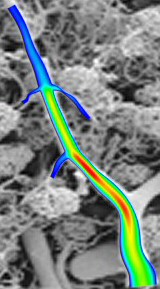
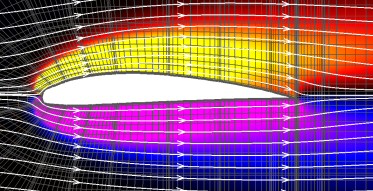
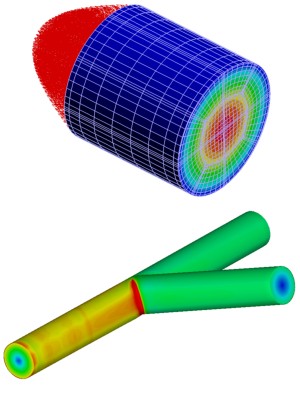
Automated curvature algorithm
VIPER employs a novel automated mesh curvature algorithm, which automatically generates a smooth curved surface (or edge in 2D) based on blended circular arc segments. This method combines superb flexibility and generality in application, while defaulting to a circular geometry when one is desired - very useful for fundamental applications of the code.
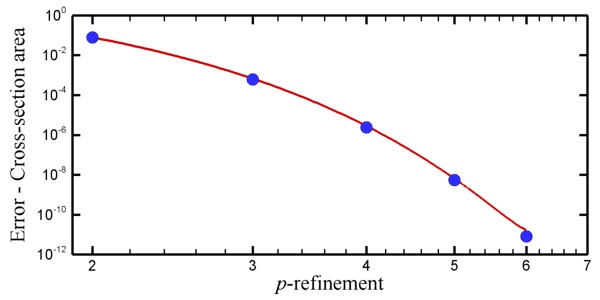
This plot shows the exponential convergence of error in a numerical estimate of the circular cross-sectional area of a mesh constructed with 8 spectral elements around the circle perimeter. Just 7 nodes in each elemental coordinate direction are sufficient to describe a circle accurate to 12 significant figures in this case!
Particle tracking
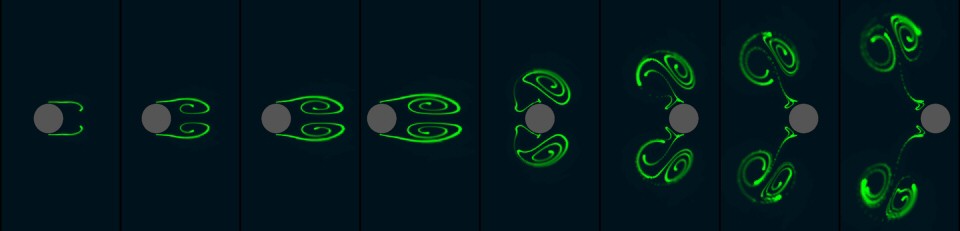
The above sequence of images simulates laser-induced fluorescent dye visualization of the two-dimensional wake behind a cylinder. The cylinder is initially at rest, and translates left for 10 time units at Reynolds number Re = 200, before being rapidly arrested. Observe how the wake vortices pair up with induced vortices due to the backwash over the cylinder, which then convect away from the cylinder in a curved trajectory due to the difference in circulation between each vortex in the pair.
Download an animation of the above sequence: [Large - 18.9 MB] [Small - 6.13 MB]
Particle tracking is performed by updating particle positions within elements using a 4th-order Runge-Kutta time integration scheme in parametric space, while a linear series of substeps is employed to step to and across element interfaces. Visualization of particles can be performed either by outputting the discrete particle locations in physical space, or by plotting the particle concentration as per the above image. The concentration is calculated based on a Gaussian distribution about each data point, with a variance calculated based on the local mesh refinement.